

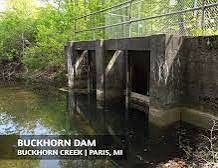
Restoring Fish Passage: Buckhorn Creek Dam Removal Signals New Chapter for Muskegon Watershed
Published: June 4, 2026
By Kayaker’s Journal Staff Writer
PARIS TOWNSHIP, Mich. — A small, aging dam on Buckhorn Creek may not look significant at first glance, but conservationists say its removal could have a lasting impact on one of Michigan’s premier trout fisheries.
In 2025, the Muskegon River Watershed Assembly received a $200,000 grant from the Great Lakes Fishery Trust to remove the obsolete Buckhorn Dam, located on Buckhorn Creek just north of Big Rapids. The project will reconnect the creek to the Muskegon River, restoring access to more than seven miles of cold-water habitat that has been cut off for decades.
The dam was originally constructed to create a mill pond associated with a former fish hatchery operation. While it served a purpose during an era when rivers were routinely modified for industry and development, the structure has long since outlived its usefulness. Today, it stands as a barrier to fish movement and a reminder of how dramatically Michigan’s waterways were altered during the state’s early development.
For fisheries biologists, the importance of the project lies in reconnecting habitat.
Buckhorn Creek remains one of the colder tributaries in the area, providing ideal conditions for trout spawning, juvenile development, and summer refuge. Yet for decades, fish moving upstream from the Muskegon River have been unable to access much of this habitat due to the dam.
Once removed, trout and other native species will regain access to over seven miles of stream corridor. The project is also expected to benefit the more than 20,000 trout stocked annually in the Muskegon River near Paris Park, giving fish additional opportunities to find cold-water refuge and reproduce naturally.
The ecological benefits extend beyond fish passage. Dams alter natural river processes by slowing water, trapping sediment, increasing water temperatures, and fragmenting aquatic habitat. Removing obsolete dams helps restore natural stream flow, improves water quality, and allows rivers to transport sediment and nutrients downstream as they have for thousands of years.
Across Michigan, dam removal has become one of the most effective tools for river restoration. Over the past two decades, dozens of aging structures have been removed, reopening hundreds of miles of habitat for fish and wildlife. Many of these projects have shown measurable improvements in stream health, biodiversity, and recreational opportunities.
The Buckhorn Creek project will also enhance the landscape surrounding the Fred Meijer White Pine Trail, one of Michigan’s most popular rail-trails. Visitors can expect a more natural stream corridor and improved scenic views as the aging structure disappears from the landscape.
For paddlers, anglers, hikers, and anyone who values healthy waterways, the Buckhorn Dam removal represents more than a construction project. It is another step in restoring the natural connections that once defined Michigan’s river systems.
More than a century after people first altered Buckhorn Creek, the waterway is poised to flow freely once again—bringing new life to the creek, the Muskegon River, and the species that depend on them.
Kayaker’s Journal will continue to follow restoration projects across Michigan that improve river health, fish habitat, and outdoor recreation opportunities for future generations.