A Century Later, the Greenside Darter Returns to the Lower Rouge
By Brad De Young | Michigan Watershed Watch
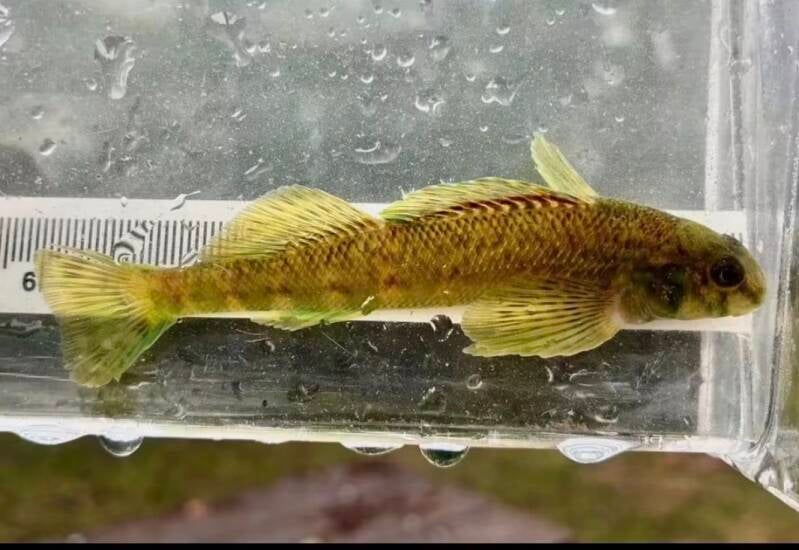
Photo: Friends of the Rouge
For more than a century, the greenside darter was absent from the Lower Rouge River.
That changed this September.
During a Friends of the Rouge fish survey near Dearborn and Inkster, staff and volunteers pulled multiple greenside darters from the river — a discovery that conservationists are calling an encouraging sign of the Rouge’s continuing recovery.
According to state fisheries records, greenside darters had not been documented in the Lower Rouge since 1924. The species was last recorded somewhere within the broader Rouge River system in 1941.
For a river that once became infamous for severe industrial pollution — including the Rouge’s highly publicized fires in the 1960s — the return of a pollution-sensitive native fish carries significance well beyond the size of the fish itself.
A fish that tells a bigger story
Greenside darters (Etheostoma blennioides) are small freshwater fish generally associated with clear, oxygen-rich water and rocky riffle habitat. Their presence can provide useful information about the condition of a river because they are less tolerant of degraded water and habitat conditions than many hardier fish species.
John Buskiewicz, a fisheries biologist with the Michigan Department of Natural Resources, described the discovery as a rare find and noted that improved water quality, sediment conditions and habitat likely contributed to creating conditions suitable for the species.
The discovery is particularly notable because Friends of the Rouge has been conducting fish surveys throughout the watershed for years. The organization has sampled different sections of the Rouge annually since 2012, creating a long-term record of the river’s fish community.
The greenside darter had not appeared in recent surveys of the Lower Rouge.
That makes its sudden appearance difficult to dismiss as simply another fish caught in a net.
Decades of work beneath the surface
The Rouge River’s recovery did not happen overnight.
Friends of the Rouge was established in 1986, with a mission centered on restoring, protecting and enhancing the Rouge River watershed through stewardship, education and collaboration.
Since then, government agencies, conservation organizations, communities, researchers and volunteers have worked on a wide range of problems throughout the watershed — from contaminated sediments and polluted runoff to habitat degradation, invasive species, fish passage and stormwater.
The Michigan Department of Natural Resources has also documented the Rouge’s fish communities and habitat conditions through fisheries assessments.
More recent restoration work has included major projects supported through the Great Lakes Restoration Initiative and Great Lakes Legacy Act. One of the largest efforts in the Lower Rouge has involved an approximately $84 million cleanup and habitat-restoration partnership addressing contaminated sediments and habitat within the Rouge River Area of Concern.
Restoration projects have included removing debris blockages, improving fish habitat, restoring wetlands and addressing contaminated sediments.
The goal of such projects is not simply to make a river look cleaner.
It is to create the physical and chemical conditions necessary for a functioning ecosystem.
The greenside darter may now be providing evidence that some of that work is producing results.
The Rouge is not finished
The discovery should not be interpreted as a declaration that the Rouge River has been completely restored.
The watershed remains heavily urbanized and industrialized, and pollution sources, stormwater, contaminated sediments and habitat problems continue to require attention.
Friends of the Rouge itself continues monitoring the river and working on restoration projects throughout the watershed.
That distinction matters.
A recovering river is not necessarily a recovered river.
But the return of a species that disappeared from the Lower Rouge for more than 100 years is precisely the kind of ecological response restoration efforts are intended to achieve.
From six fish species to a changing river
The Rouge’s transformation becomes even more striking when viewed over several decades.
Historical monitoring documented a severely degraded fish community. More recent surveys have recorded substantially greater fish diversity, including species that require better water-quality and habitat conditions.
Friends of the Rouge reported that its September survey of the Lower Rouge also found northern logperch, rock bass and northern hogsuckers — species considered relatively intolerant of pollution.
The greenside darter therefore joins a broader story.
The river’s recovery is being measured not only in dollars spent, dredged sediment or completed restoration projects, but in the organisms capable of living there.
That is one of the most powerful ways to measure whether restoration is actually working.
A small fish with a big message
Greenside darters are only a few inches long.
But their return represents something much larger.
For decades, the Rouge was viewed primarily through the lens of its industrial legacy — a river burdened by pollution and habitat destruction.
Today, scientists and conservationists are increasingly able to study a different Rouge: one where native fish are returning, habitat is being restored and biological diversity is increasing.
The greenside darter’s return does not erase the Rouge’s history or eliminate the work that remains.
Instead, it offers something conservation efforts desperately need: measurable evidence that persistence can change a river.
More than 100 years after the greenside darter was last documented in the Lower Rouge, the fish is back.
And for those who have spent decades working to restore the watershed, that may be one of the clearest signs yet that the Rouge is moving in the right direction.
Photo credit: Friends of the Rouge
Sources: Friends of the Rouge; Michigan Department of Natural Resources; Detroit Free Press; University of Michigan School for Environment and Sustainability.