Michigan Watershed Watch | West Michigan Kayaking Club
September 3, 2026
A 1950s industrial crossing is finally coming out of the Shiawassee River. But as taxpayers and conservation funding pick up the cost, questions remain about the companies whose operations were tied to the structure.
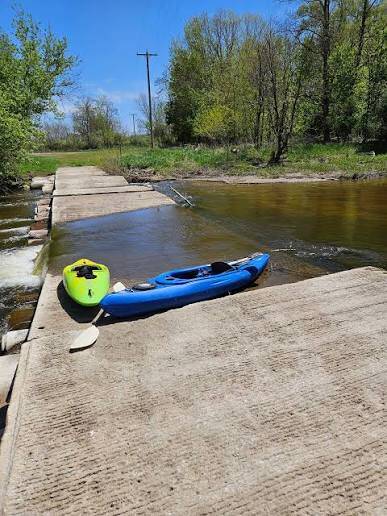
CORUNNA, Mich. — For more than seven decades, a 185-foot causeway has stood across the Shiawassee River, a relic of an industrial era when the river was viewed primarily as a resource to be crossed, controlled and used.
Today, the river is being viewed differently.
The deteriorating structure is considered an obstruction to aquatic-organism passage and river connectivity. Its removal is expected to restore a more natural connection through the river corridor and improve conditions for fish, wildlife and recreational paddlers.
The project, however, raises a question that goes beyond environmental restoration:
Who should pay to remove an industrial structure that was built to serve private commercial interests?
The answer is not as simple as looking at the name historically associated with the causeway.
THE MERIDIAN BRICK CONNECTION
Government documents have referred to the structure as the Meridian Brick causeway.
The causeway was constructed in the 1950s to provide access to shale-mining operations on the opposite side of the Shiawassee River. The structure became associated with the brick manufacturing operation that operated on the property.
A Michigan environmental survey documented the crossing as part of the former brick-plant operation and identified its potential effects on river connectivity.
The Michigan Department of Natural Resources later identified the structure as a priority obstruction to aquatic-organism passage. (West Michigan Kayaking Club)
The history is clear enough to establish a connection between the industrial operation and the causeway.
But history alone does not necessarily establish legal liability.
MERIDIAN BRICK IS GONE. MICHIGAN BRICK REMAINS.
One of the most important pieces of the story is the corporate transition that occurred several years ago.
Meridian Brick is no longer the company operating the Corunna facility under that name.
General Shale acquired Meridian Brick in 2021. Following the acquisition, the Corunna operation was rebranded Michigan Brick as part of General Shale’s new branding strategy.
That means the company name appearing in historical records—Meridian Brick—is not necessarily the same legal entity that owns or operates the property today.
And that distinction could make pursuing the former company for the cost of removing the causeway extraordinarily complicated.
FOLLOWING THE MONEY
The current removal project is estimated at approximately $127,900.
Publicly identified funding includes approximately $87,573 from the Michigan Department of Natural Resources Fisheries Habitat Grant Program and approximately $40,300 in local funding.
Together, those sources account for essentially the entire reported project cost.
What is missing from the publicly identified funding is a documented contribution from Meridian Brick, Michigan Brick or General Shale.
That does not necessarily mean the company has provided no assistance whatsoever.
A company can assist a project by granting property access, providing cooperation, allowing contractors onto its property or addressing easements without writing a check toward the construction cost.
But as of the information publicly available for this project, there is no documented financial contribution from Michigan Brick or General Shale toward the approximately $127,900 removal cost.
That distinction matters.
WHY NOT JUST SEND THE BILL TO MERIDIAN?
At first glance, the answer might seem obvious.
If government records call it the Meridian Brick causeway, why not make Meridian Brick pay?
Because the company associated with that name has been sold.
General Shale acquired Meridian Brick’s operations in 2021, and the Corunna facility subsequently became Michigan Brick.
That raises a much more complicated legal question:
Did any responsibility for an abandoned industrial structure transfer with the property or business, and if so, to whom?
Answering that question would require examining the actual corporate transaction documents, historical deeds, easements, environmental permits and agreements concerning the causeway.
The name on an old government document is not enough.
Neither is the fact that a modern company occupies the same industrial site.
SEVEN DECADES OF CORPORATE CHANGE
The causeway dates to the 1950s.
That is more than 70 years of history.
During that time, industrial operations changed hands. Company names changed. Corporate assets were bought and sold. Property boundaries may have changed. Regulations governing rivers and environmental contamination evolved.
The structure, meanwhile, remained in place.
That creates an unusual situation in which the environmental consequences of an old industrial project remain long after the corporate landscape surrounding it has changed.
Attempting to establish legal responsibility today could require reconstructing that entire history.
And that can be expensive.
THE COST OF PURSUING THE COST
There is another practical consideration.
Suppose local officials decided to pursue a former company for the cost of removing the causeway.
Before that could happen, attorneys would likely need to establish:
- Who originally owned the structure?
- Who owned the land beneath and surrounding it?
- Was the causeway included in subsequent property transfers?
- Were there easements governing the crossing?
- Did any purchaser assume responsibility for the structure?
- Did environmental obligations transfer with the property?
- Which corporate entity would legally be responsible today?
- Are those obligations still enforceable after decades of corporate transactions?
Those questions could require extensive legal and historical research.
Even if a case could eventually be made, litigation could delay the environmental restoration the river needs today.
That is one reason public conservation funding can become the practical solution.
COOPERATION IS NOT LIABILITY
There is evidence that landowners have cooperated with efforts to remove the causeway.
A January 2025 document associated with the Shiawassee River Water Trail Coalition described work toward removal and acknowledged voluntary cooperation from landowners.
That is important.
But cooperation should not be confused with financial responsibility.
A landowner can allow access for a restoration project without agreeing to pay for it.
Likewise, a current property owner can cooperate with environmental restoration without accepting legal responsibility for a structure built decades before its current ownership.
THE ENVIRONMENTAL ARGUMENT
From the perspective of river restoration, the case for removing the causeway is considerably simpler.
The DNR has identified the structure as an obstruction to aquatic-organism passage.
Removing barriers can reconnect habitat and allow aquatic species to move through river systems more naturally.
For paddlers, the benefits are also tangible.
A river that is more connected ecologically can also become more connected recreationally.
The Shiawassee is increasingly being recognized not simply as an industrial waterway but as a recreational and ecological resource.
That transformation is part of a larger shift in how Michigan communities view their rivers.
BUT SHOULD TAXPAYERS PAY?
This is where the story becomes more complicated.
There is a legitimate public interest in restoring rivers.
There is also a legitimate public interest in asking whether private industry should contribute to the cost of removing infrastructure created for private commercial purposes.
Those two ideas are not mutually exclusive.
The public may benefit from the restoration.
But that does not automatically answer whether the private sector should have financial responsibility for the cleanup.
Without the historical deeds, easements and corporate agreements, it would be irresponsible to declare that Michigan Brick, General Shale or Meridian Brick is legally responsible.
But it would be equally premature to say the opposite.
THE QUESTION THAT DESERVES AN ANSWER
The public record currently tells us that:
The causeway is historically associated with the brick industry.
The structure was built to facilitate industrial activity.
Government agencies now consider it an obstruction to river connectivity.
Meridian Brick is no longer the company operating the Corunna facility under that name.
The facility is now associated with Michigan Brick and General Shale.
The approximately $127,900 removal project is being financed through publicly identified grant and local funding.
No publicly documented financial contribution from Michigan Brick, General Shale or Meridian Brick has been identified in the records reviewed for this report.
What remains unanswered is the most important question:
Who legally inherited responsibility for the causeway?
That question deserves an answer—not because the goal should necessarily be to send a bill to a private company, but because taxpayers and conservation organizations have a right to understand how responsibility for old industrial infrastructure is determined.
The Shiawassee River is finally getting an opportunity to move forward.
The question is whether the financial responsibility for the past should move forward with it.
MICHIGAN WATERSHED WATCH
This investigation is presented from the perspective of Michigan Watershed Watch and the West Michigan Kayaking Club, with a focus on Michigan’s rivers, water trails, conservation, public access and responsible stewardship.
The West Michigan Kayaking Club is an adventure-focused Michigan paddling community dedicated to exploring and protecting the state’s waterways through kayaking, hiking, camping, education and stewardship. (West Michigan Kayaking Club)
Follow the West Michigan Kayaking Club:
🌐 West Michigan Kayaking Club Website
📘 West Michigan Kayaking Club Facebook Group
West Michigan Kayaking Club
Wild Rivers. Rugged Trails. Real Adventure.