By Brad De Young
Michigan Watershed Watch / West Michigan Kayaking Club
September 21, 2026
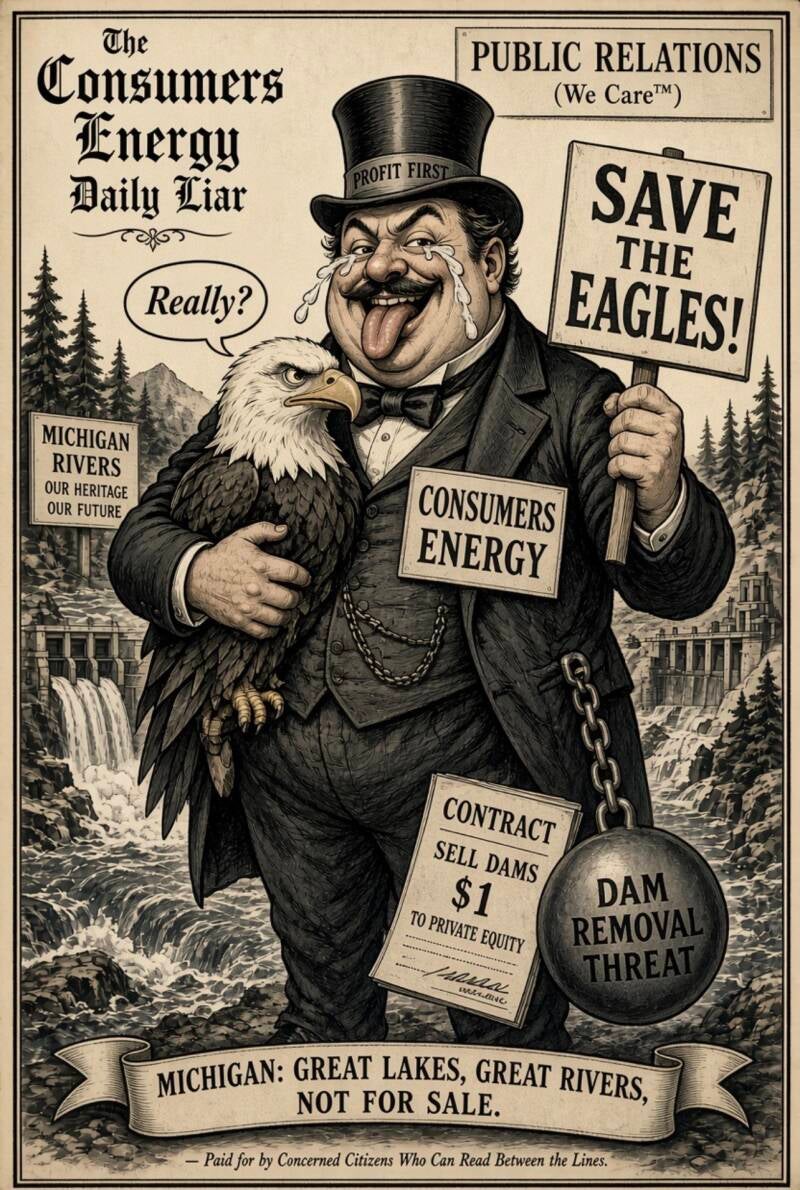
Just months ago, Consumers Energy was openly threatening to tear down its aging hydroelectric dams across Michigan’s rivers if state regulators didn’t rubber-stamp a sweetheart deal to unload them. Now, in a breathtaking pivot, the utility is wrapping itself in the American flag and the bald eagle, insisting that selling those same dams to a private equity firm is somehow essential to protecting the national bird.
This is not conservation. This is desperation dressed up as environmental concern. And it is pathetic.
For years, Consumers Energy treated its 13 dams on the Au Sable, Manistee, Muskegon, Grand, and Kalamazoo rivers as costly liabilities. The company itself has said the structures generate a tiny fraction of its power while running at a massive annual loss. When the proposed sale to Confluence Hydro—a subsidiary of Maryland-based private equity firm Hull Street Energy—for the princely sum of $1 per dam hit resistance, Consumers didn’t hesitate. Company executives made clear they would rather decommission the dams than accept meaningful conditions that might protect ratepayers or public safety. Removal was on the table. The reservoirs communities have grown around, the recreational economies, the very landscapes people love—those were expendable if the deal didn’t go exactly their way.
Yet suddenly, the same company that was prepared to erase these impoundments is rediscovering its inner wildlife biologist. The dams, we are now told, create vital habitat for bald eagles. The backwaters provide nesting sites and cleaner fish above the barriers. Consumers has long pointed to decades-old management plans and fledgling counts as proof of its stewardship. Fair enough—the utility has publicized those claims for years. But the timing of this latest full-throated appeal is not coincidence. It arrives precisely when an administrative law judge has recommended rejecting the sale as inconsistent with the public interest, when the Attorney General has raised alarms about ratepayer costs, when Governor Whitmer’s administration has expressed skepticism, and when the Michigan Public Service Commission is still weighing whether to approve a transaction that locks customers into paying roughly double the market rate for the dams’ meager power output for three decades—while Consumers pockets a substantial profit.
This is the classic utility playbook: when the numbers look bad and the politics turn against you, reach for the charismatic megafauna. Suddenly the bald eagle becomes the reason private equity must take ownership. Suddenly the company that was ready to remove the dams is the bleeding-heart guardian of raptors. The message to lawmakers and the public is clear: approve this deal or the eagles will suffer. Never mind that the eagles recovered dramatically across Michigan and the country after DDT and PCBs were controlled. Never mind that genuine habitat protection does not require handing century-old high-hazard dams to an out-of-state investment firm with no deep roots in Michigan communities. Never mind that the real questions—dam safety, flood risk, river health, sediment, fish passage, and who ultimately foots the bill when private owners decide maintenance is no longer profitable—remain unresolved.
Consumers Energy is not a conservation organization. It is a regulated monopoly seeking to shed expensive assets while extracting maximum value for its shareholders. The private equity buyer has every incentive to minimize costs once the initial power-purchase agreement is locked in. Ratepayers will be on the hook for premium power prices. Taxpayers may eventually face the cleanup or the consequences of deferred maintenance. And the eagles? They will do what eagles do—adapt, nest where conditions allow, and continue their recovery with or without this particular corporate narrative.
The sudden concern for bald eagles is not a principled stand. It is a last-ditch public-relations maneuver by a company that spent months threatening the opposite outcome. Michiganders who care about their rivers, their wallets, and yes, even their eagles, should see this for what it is: a desperate attempt to salvage a flawed deal. The dams’ future deserves honest debate about costs, safety, ecology, and accountability—not emotional blackmail wrapped in feathers.
Brad De Young Founder of West Michigan Kayaking Club writes on Michigan rivers, utilities, and public policy for Michigan Watershed Watch.