Ancient Red Pines: A Living Connection to Michigan’s Wild Past
By Brad De Young | Michigan Watershed Watch
NEWBERRY, Mich. — Along the rugged shores of Lake Superior, a remarkable piece of Michigan’s natural history has survived largely hidden from view.
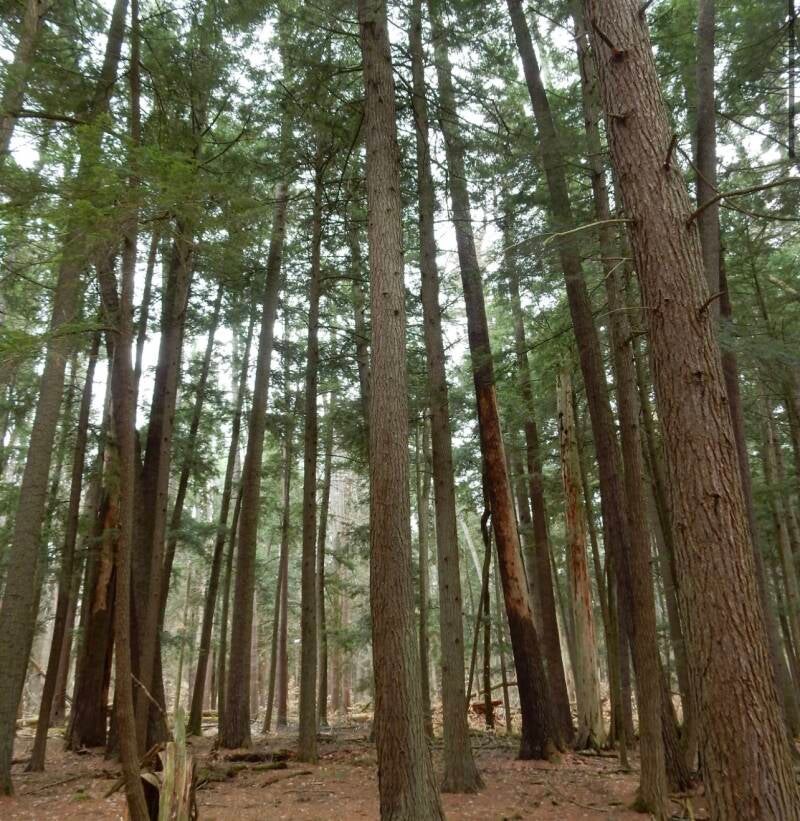
Michigan foresters have discovered a stand of old-growth red pines on state-owned land near the Two-Hearted River, with some of the towering trees believed to have been growing for centuries—possibly dating to before European settlement of the Great Lakes region.
The discovery is significant not simply because of the age of the trees, but because of what they represent.
During Michigan’s massive lumber boom in the 1800s, much of the state’s original red and white pine forest was harvested. Rivers became the highways that carried enormous quantities of timber downstream to sawmills and communities throughout Michigan and beyond.
What remains today is only a fraction of those once-vast forests.
That makes the surviving red pines near the Two-Hearted River especially valuable.
“That is the biggest concentration of old-growth red pine that I’ve seen yet in my career,” said Mary Parr, an ecologist and fire science expert with the Michigan Natural Features Inventory.
A Forest That Survived Michigan’s Lumber Boom
Michigan’s forests helped build the state’s early economy, but the transformation came at an enormous ecological cost. Vast stands of white pine, red pine, hemlock and other native trees were cut during the 19th-century logging era.
Many forests were harvested so extensively that the original landscape was fundamentally changed.
The old-growth red pines near the Two-Hearted River offer something increasingly rare: a living connection to the forests that existed before that transformation.
These are not simply old trees. They are part of an ecosystem shaped by natural processes—including fire, wind, wildlife and centuries of forest succession.
Why It Matters to Michigan’s Watersheds
For Michigan Watershed Watch, the discovery is also a reminder that healthy watersheds begin far beyond the water’s edge.
The forests surrounding Michigan’s rivers, streams and Great Lakes shorelines play an important role in protecting water quality. Forest vegetation helps stabilize soil, slow runoff, reduce erosion and provide shade and organic material that support aquatic ecosystems.
The Two-Hearted River is one of Michigan’s iconic wild rivers, flowing through the Upper Peninsula before reaching Lake Superior.
Protecting the forests surrounding rivers like the Two-Hearted is about more than preserving beautiful scenery. It is about protecting the interconnected systems that carry water from the land to our rivers and ultimately into the Great Lakes.
A Living Piece of Michigan’s Wild History
Perhaps the most remarkable part of this discovery is simply that these trees survived.
They survived an era when Michigan’s forests were being harvested on an enormous scale. They survived generations of environmental change and the pressures that transformed much of Michigan’s original landscape.
Now they stand as living witnesses to a Michigan that existed long before modern development.
For paddlers, hikers, anglers, conservationists and anyone who spends time outdoors, places like the Two-Hearted River offer a powerful reminder that our recreational landscapes are also ecological treasures.
The West Michigan Kayaking Club encourages paddlers to explore Michigan’s rivers and wild places while developing a deeper appreciation for the natural resources that make those adventures possible.
Discoveries like this should encourage all of us to look differently at the remaining pieces of Michigan’s wild landscape. An undeveloped forest, an intact wetland, a free-flowing river or an old-growth stand may represent far more than recreational space.
It may be a piece of ecological history that cannot be replaced once it is gone.
The ancient red pines near the Two-Hearted River remind us that conservation isn’t always about creating something new.
Sometimes, it’s about recognizing what managed to survive—and making sure it survives for generations to come.
Michigan Watershed Watch is committed to highlighting Michigan’s rivers, forests, wetlands, Great Lakes and the people working to protect them.
Wild Rivers. Rugged Trails. Real Adventure.