By Brad De Young
The Kayaker’s Journal / West Michigan Kayaking Club
Some people paddle for a weekend.
Some paddle for a season.
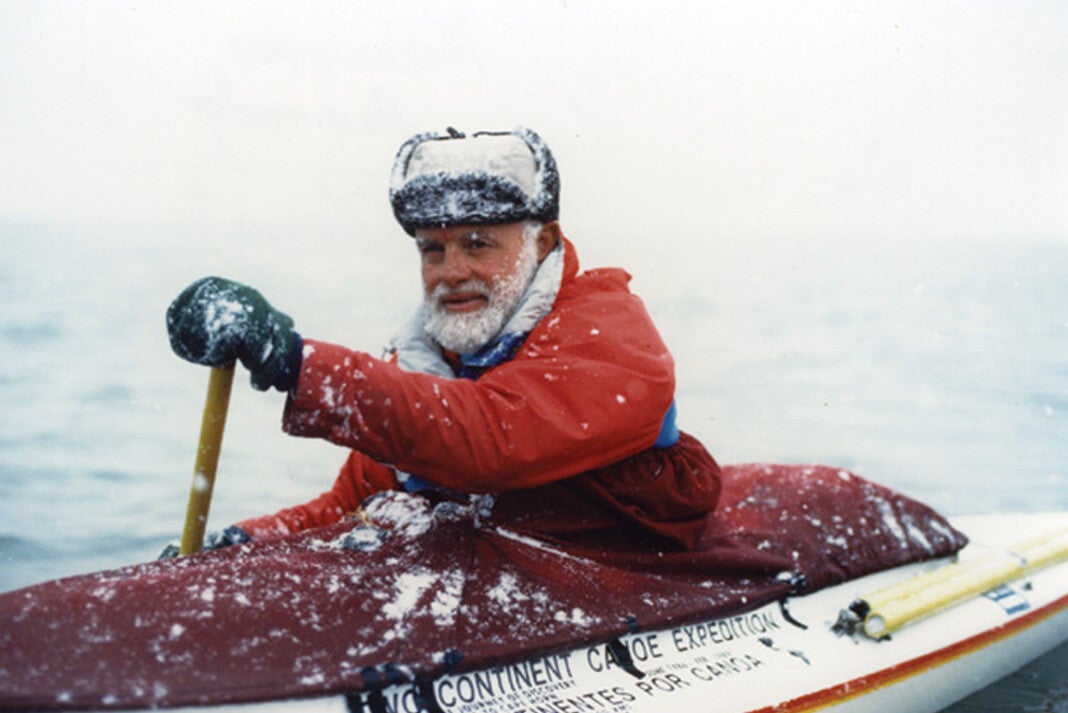
Verlen Kruger paddled for a lifetime.
Few names in Michigan paddling history carry the same significance as Verlen Kruger.
He was an expedition canoeist, adventurer, innovator, teacher and relentless traveler who transformed what people thought was possible in a canoe.
Over the course of his life, Kruger paddled more than 100,000 miles. He completed enormous expeditions across North America and beyond, established multiple records and became one of the most recognizable figures in American expedition canoeing. (Paddling Magazine)
But perhaps the most remarkable part of Verlen Kruger’s story isn’t the number of miles.
It’s when he started.
The Paddler Who Started at 41
Verlen Kruger was born in Indiana in 1922 and eventually made Michigan his home.
Unlike many accomplished paddlers, Kruger wasn’t raised as a lifelong canoe racer.
He didn’t spend his childhood competing in canoe races.
He didn’t begin his career as a young professional athlete.
His serious paddling career began when he was approximately 41 years old. (WMEAC)
For most people, 41 is an age when they begin thinking about slowing down.
Kruger was just getting started.
That may be one of the most important parts of his story.
His life demonstrates that adventure doesn’t have an expiration date.
You don’t have to begin at 15.
You don’t have to be a professional athlete.
You don’t have to have spent your entire life on the water.
You can start.
And then keep going.
From Michigan to the World
Kruger’s paddling career eventually became extraordinary.
He wasn’t interested in simply floating down a river for an afternoon.
He wanted to explore.
He wanted to travel farther.
He wanted to connect waterways.
He wanted to discover what was possible when a person relied primarily on a canoe, a paddle and their own determination.
Over decades, those ambitions carried him across enormous distances.
His expeditions eventually totaled more than 100,000 miles of paddling, a figure that places him among the most prolific expedition canoeists in history. (Paddling Magazine)
He paddled the Mississippi River multiple times.
He crossed enormous stretches of North America.
He completed the Two Continent Canoe Expedition, a journey of approximately 18,000 miles.
He later participated in the Ultimate Canoe Challenge, an expedition of more than 28,000 miles that has been described as the longest canoe journey ever undertaken. (Wikipedia)
These weren’t casual camping trips.
They were massive human-powered expeditions.
The Grand River Connection
For Michigan paddlers, Kruger’s story becomes even more important because of his relationship with the Grand River.
Kruger became deeply involved in efforts to explore, document and celebrate Michigan’s waterways.
One of the most important chapters began with another Michigan paddling legend:
Hugh Heward.
In 1790, British fur trader Hugh Heward and his French-Canadian crew traveled across Michigan by canoe.
One day of that historic expedition involved an extraordinary downstream journey on the Grand River.
More than 200 years later, historian and topologist Jim Woodruff became fascinated by Heward’s story.
Woodruff studied historical maps, geography and Heward’s journal and attempted to reconstruct the historic route.
Then he approached Kruger.
Could modern paddlers duplicate what Heward’s crew had done?
Kruger accepted the challenge.
Verlen Kruger Takes on Hugh Heward
In preparation for the Grand River Expedition of 1990, Woodruff and Kruger worked together to investigate Heward’s historic route.
Kruger didn’t simply accept Woodruff’s theory.
He went out and tested it.
According to Woodruff’s historical account, Kruger launched on the Huron River and worked his way through the difficult connection toward the Grand River, including carrying his canoe through challenging terrain.
It took him approximately two days to make the crossing.
He proved that the route Woodruff had reconstructed was physically possible. (The Topologist)
That exploration helped revive the story of Hugh Heward.
And then came another idea.
If Heward’s crew could paddle approximately 50 miles down the Grand River in one day in 1790…
Could modern paddlers do it too?
The Hugh Heward Challenge Is Born
Woodruff issued the challenge.
Kruger accepted.
And other paddlers joined them.
The Hugh Heward Challenge was born.
The event reenacts the historic one-day sprint down the Grand River associated with Heward’s April 24, 1790 journey. The modern challenge has become an annual Michigan paddling tradition. (Kruger Legacy)
What started as a historical question became a real-world test.
Modern paddlers could follow the route.
They could experience the distance.
They could discover what 50 miles on the Grand River actually feels like.
And they could connect their own adventure to a journey that began more than two centuries earlier.
Kruger helped turn history into something paddlers could experience.
But Heward Was Only the Beginning
It would be easy to remember Kruger simply as the man associated with the Hugh Heward Challenge.
That would barely scratch the surface.
The Heward story was one chapter in a paddling career that eventually covered an almost unimaginable distance.
Kruger’s expeditions took him across rivers, lakes, wilderness areas and international borders.
He wasn’t simply collecting miles.
He was developing a philosophy of expedition paddling.
Go farther.
Learn the water.
Prepare carefully.
Solve problems.
Keep moving.
And don’t assume that something is impossible simply because nobody has done it before.
The Two-Continent Canoe Expedition
Among Kruger’s most extraordinary accomplishments was the Two Continent Canoe Expedition.
The journey covered approximately 18,000 miles and crossed enormous portions of North America. (Wikipedia)
Think about what that means.
Eighteen thousand miles isn’t simply a long canoe trip.
It is a way of life.
Weeks become months.
Months become years.
Every mile requires decisions.
Where do you camp?
Where do you find food?
How do you handle weather?
How do you repair equipment?
How do you navigate?
How do you keep moving when you’re exhausted?
That’s expedition paddling.
And Kruger became one of its great practitioners.
The Ultimate Canoe Challenge
Kruger’s appetite for exploration eventually led to an even more ambitious undertaking.
The Ultimate Canoe Challenge covered more than 28,000 miles.
The journey has been described as the longest canoe journey ever undertaken. (Wikipedia)
For most paddlers, a 20-mile day is a significant accomplishment.
For Kruger, the question was often measured in thousands.
That difference in scale is difficult to comprehend.
But Kruger’s adventures weren’t simply about proving that he could paddle farther than everyone else.
They were about exploration.
They were about seeing what existed beyond the familiar.
And they demonstrated how far human-powered travel could take someone willing to dedicate his life to it.
The Mississippi
The Mississippi River became another defining part of Kruger’s story.
He traveled the length of the river multiple times during his life. (Paddling Magazine)
For many paddlers, completing the Mississippi would be the adventure of a lifetime.
Kruger kept returning.
The river became less like a destination and more like an old friend.
He understood that rivers change.
Water levels rise and fall.
Weather changes.
Communities change.
Dams alter the landscape.
New obstacles appear.
And every journey teaches something new.
That philosophy became central to Kruger’s approach to paddling.
The River Was the Classroom
Kruger wasn’t simply interested in covering distance.
He learned from the water.
Every river presented different problems.
Every expedition required preparation.
Every long trip demanded adaptation.
A canoe could be beautifully designed, but the paddler still had to understand the river.
A map could show the route, but conditions could change.
Equipment could fail.
Weather could turn.
Plans could change.
The ability to solve problems became just as important as physical endurance.
That’s one of the reasons Kruger’s legacy remains relevant to modern paddlers.
Verlen Kruger and Canoe Design
Kruger’s influence extended beyond the miles he paddled.
He was deeply involved in canoe design and developed boats intended for long-distance expedition travel.
The goal wasn’t simply speed.
A serious expedition canoe needs to balance multiple demands:
Efficiency.
Stability.
Durability.
Cargo capacity.
Comfort.
Tracking.
Maneuverability.
A boat that performs beautifully for ten miles may not be the right boat for a journey of thousands.
Kruger understood that difference.
His experience on the water informed his approach to designing and refining expedition canoes.
The Ultimate Test of Equipment
Imagine being thousands of miles from home.
Your canoe isn’t sitting on a rack in your garage.
It’s your transportation.
Your equipment isn’t a collection of recreational toys.
It’s your expedition system.
If something breaks, you repair it.
If something doesn’t work, you adapt.
If you discover a better way, you change your system.
Kruger’s enormous mileage gave him a unique understanding of what expedition equipment needed to accomplish.
He wasn’t designing for the weekend paddler.
He was designing for the person who planned to keep going.
Kruger and the Grand River
Michigan paddlers have another reason to remember Kruger.
He helped establish the Grand River as something more than a local waterway.
Through the Grand River Expedition and related projects, Kruger and other paddlers helped bring attention to the river’s history, geography and recreational potential.
The Grand River could be viewed as an adventure.
It could be viewed as a historical corridor.
It could be viewed as a statewide resource.
And it could be experienced from the seat of a canoe or kayak.
That philosophy continues today.
A Legacy on the River
Kruger’s legacy is physically represented in Michigan.
The Verlen Kruger Legacy preserves his history and maintains landmarks associated with his life and expeditions.
Kruger Landing, for example, provides a canoe launch along the Red Cedar River in Lansing.
A Michigan Heritage Memorial commemorates the Ultimate Canoe Challenge.
And Kruger’s name is preserved on the Michigan Canoe Racing Association Canoer’s Memorial Monument near the Au Sable River. (Kruger Legacy)
These aren’t simply monuments to a man.
They are reminders of a philosophy:
Explore. Paddle. Learn. Keep moving.
The Verlen Kruger Challenge
Today, the Kruger legacy continues through paddling events created in his honor.
The Verlen Kruger Legacy Race celebrates the expedition paddler whose life demonstrated just how far canoe travel could go.
The event brings paddlers together to challenge themselves on the water while preserving Kruger’s story and the culture surrounding Michigan expedition paddling. The race is part of a broader effort to keep Kruger’s history alive through paddling, storytelling and community. (West Michigan Kayaking Club)
For paddlers, events like this provide something important.
They create a connection between the people who explored these waterways decades ago and the people exploring them today.
The boat may be different.
The paddle may be different.
The clothing may be different.
But the river is still there.
West Michigan Kayaking Club Proudly Supports the Legacy
In 2026, West Michigan Kayaking Club became a proud sponsor of the Verlen Kruger Legacy Race.
For our club, supporting this event is about more than putting our name on a sponsorship list.
It’s about recognizing the people who helped shape Michigan paddling.
Verlen Kruger represents the kind of adventure that West Michigan Kayaking Club believes in:
Go farther.
Explore more.
Learn the waterways.
Challenge yourself.
Respect the river.
Pass the knowledge forward.
Our club exists to bring paddlers together and create opportunities to experience Michigan’s rivers, lakes, trails and wilderness.
Supporting the Kruger Legacy fits naturally into that mission.
Because today’s paddlers are standing on the shoulders of the people who explored these waterways before us.
And Verlen Kruger was one of those people.
Why West Michigan Paddlers Should Know His Name
If you paddle Michigan today, you are part of a much larger story.
Every time you launch a kayak on the Grand River, paddle the Muskegon, explore the Manistee, travel the Au Sable or venture onto one of Michigan’s countless inland waterways, you’re participating in a tradition that stretches back generations.
Kruger pushed that tradition farther.
Much farther.
He demonstrated that a canoe wasn’t merely something you used to spend an afternoon on the water.
It could be a vehicle for exploration.
A means of transportation.
A home away from home.
A tool for discovering places most people would never see.
The Adventure Doesn’t Have to Be 28,000 Miles
One of the easiest mistakes when reading Kruger’s story is thinking that you have to imitate his mileage to understand his philosophy.
You don’t.
You don’t have to paddle 100,000 miles.
You don’t have to cross a continent.
You don’t have to spend months on an expedition.
You can start with 10 miles.
Then 20.
Then 30.
Maybe someday 50.
Maybe you paddle a river you’ve never seen.
Maybe you camp along the way.
Maybe you learn to navigate.
Maybe you develop rescue skills.
Maybe you plan a multi-day expedition.
The important part isn’t the number.
It’s the willingness to explore.
The 41-Year-Old Who Kept Going
Perhaps the most inspiring part of Verlen Kruger’s story is where it began.
He didn’t start his legendary paddling career as a teenager.
He started around age 41.
Then he spent the rest of his life seeing just how far a canoe could take him.
His story is a reminder that adventure isn’t reserved for the young.
It’s not reserved for professionals.
It’s not reserved for people who grew up paddling.
Sometimes the greatest adventure begins when you decide to try something new.
And then you don’t stop.
What Kruger Left Behind
Verlen Kruger died in 2004.
But the miles didn’t disappear.
The routes didn’t disappear.
The boats didn’t disappear.
The stories didn’t disappear.
The people he inspired didn’t disappear.
His name remains connected to Michigan rivers, canoe expeditions, the Grand River, the Hugh Heward Challenge and generations of paddlers who continue to explore the waterways he loved. (Kruger Legacy)
That’s a powerful legacy.
A person can only paddle one river at a time.
But the inspiration created by that journey can travel much farther.
From Verlen Kruger to the Next Generation
Today’s paddlers have technology Kruger never had.
GPS.
Satellite communication.
Lightweight composite boats.
Modern navigation apps.
Weather radar.
High-performance clothing.
Advanced safety equipment.
But technology doesn’t replace adventure.
It simply changes the tools.
The fundamental experience remains the same.
You put the boat in the water.
You pick up the paddle.
You push away from shore.
And you begin moving.
The Next Generation of Michigan Paddlers
That’s why preserving stories like Verlen Kruger’s matters.
Young paddlers need to know that Michigan has its own expedition legends.
People who crossed continents.
People who paddled tens of thousands of miles.
People who explored the rivers running through the communities we live in today.
People who believed that a river could take you somewhere.
And that somewhere was worth going.
The Journey Continues
Hugh Heward showed what was possible when a traveler used Michigan’s rivers as highways.
Verlen Kruger showed what was possible when someone dedicated an entire lifetime to exploring those highways.
One journey crossed Michigan.
The other crossed continents.
Both began with the same simple act:
Put the canoe in the water.
For today’s paddlers, the lesson remains.
You don’t know what is around the next bend.
You don’t know where the next river will take you.
You don’t know what adventure is waiting beyond the next access point.
But you can find out.
You just have to go.
Remembering Verlen Kruger
Verlen Kruger left Michigan paddling with something bigger than a list of records.
He left a culture of adventure.
A belief in exploration.
A respect for rivers.
A commitment to expedition travel.
And an example that one person can inspire generations of paddlers.
At The Kayaker’s Journal / West Michigan Kayaking Club, we’re proud to help carry that story forward.
In 2026, West Michigan Kayaking Club is proud to support the Verlen Kruger Legacy Race and the continued preservation of Kruger’s remarkable contribution to Michigan paddling. (West Michigan Kayaking Club)
Because the best way to honor an explorer isn’t simply to remember where he went.
It’s to keep exploring.
🌊 Wild Rivers. Rugged Trails. Real Adventure.
Continue Exploring
🌐 West Michigan Kayaking Club
westmichigankayakingclub.online
📘 West Michigan Kayaking Club Facebook Group
Join the West Michigan Kayaking Club Facebook Group
Verlen Kruger Legacy
Verlen Kruger Legacy — Hugh Heward Challenge & Kruger history
The Kayaker’s Journal
Stories • History • Adventure • Gear • Michigan Paddling
By Brad De Young
The Kayaker’s Journal / West Michigan Kayaking Club
#MichiganPaddlingLegends #VerlenKruger #VerlenKrugerLegacy #VerlenKrugerChallenge #MichiganCanoeing #MichiganKayaking #MichiganPaddling #GrandRiver #HughHeward #HughHewardChallenge #ExpeditionPaddling #TheKayakersJournal #WestMichiganKayakingClub #WildRivers #RuggedTrails #RealAdventure