By Brad De Young
Founder, West Michigan Kayaking Club
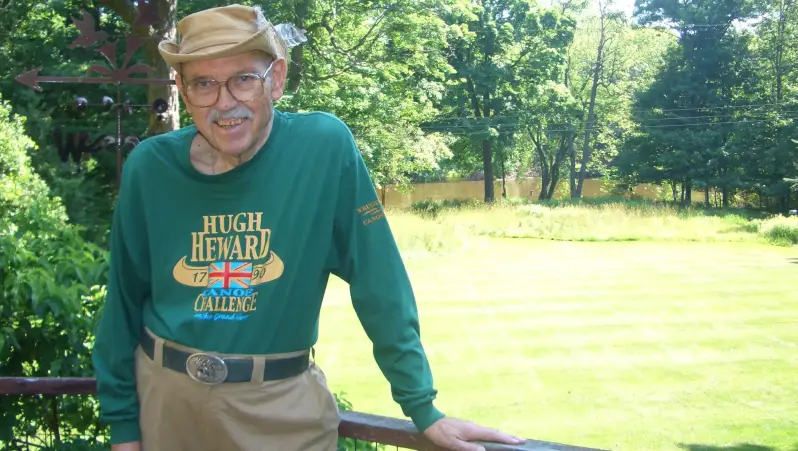
Michigan paddling legends Jim Woodruff — The Man Who Put History Back on the River
By West Michigan Kayaking Club
Wild Rivers. Rugged Trails. Real Adventure.
The Grand River was moving long before anyone thought about racing it.
Long before fiberglass canoes.
Long before carbon paddles.
Long before GPS tracks, dry bags, satellite communicators and shuttle vehicles.
In 1790, it was simply a highway through a wilderness.
And somewhere along that river, a British fur trader named Hugh Heward was trying to cross Michigan.
More than 200 years later, a Michigan historian named Jim Woodruff became obsessed with figuring out exactly how he did it.
Woodruff didn’t have Heward’s canoe.
He didn’t have his maps.
He didn’t have his voyageurs.
What he had were fragments.
Old journals.
Historical accounts.
Topographic maps.
Rivers that had changed.
Roads that didn’t exist.
And a question that refused to go away:
Could the route Hugh Heward traveled in 1790 still be followed today?
The answer would eventually involve one of the greatest expedition paddlers Michigan has ever produced.
Verlen Kruger.
And it would lead to one of Michigan’s most distinctive paddling traditions:
the Hugh Heward Challenge.
A Journey Lost in Time
In the late 18th century, Michigan was a vastly different place.
There were no interstate highways crossing the Lower Peninsula.
No bridges carried traffic over the Grand River.
No road signs pointed toward Lansing, Portland or Grand Rapids.
For travelers, the rivers were the roads.
Hugh Heward was part of that world.
In 1790, the British fur trader and a group of French-Canadian voyageurs traveled across Michigan by canoe and portage, making their way westward toward the Chicago River.
Their route required an intimate knowledge of the landscape.
A river might provide miles of effortless transportation.
Then suddenly it could disappear.
The travelers would have to drag their canoes out of the water, shoulder their equipment and cross miles of forest before reaching another navigable stream.
It was a world where knowing the landscape could mean the difference between reaching your destination and becoming hopelessly lost.
And one portion of Heward’s journey was particularly intriguing.
The Grand River.
Historical accounts indicated that Heward’s party traveled approximately 50 miles down the Grand River in a single day.
For a modern paddler, that’s an impressive distance.
For someone traveling in 1790?
It was extraordinary.
And for Jim Woodruff, it was irresistible.
The Man With the Maps
Woodruff approached Michigan differently than most paddlers.
He looked at the state from above.
Topographic lines.
River systems.
Old transportation corridors.
Portage routes.
Historical settlements.
Drainages.
He understood that rivers weren’t isolated pieces of water.
They were connected.
And long before modern roads divided Michigan into counties and townships, those connections created a natural transportation network.
Woodruff began reconstructing Heward’s route.
It wasn’t a simple matter of finding a river on a modern map.
The Michigan Heward traveled had been transformed.
Streams had been straightened.
Wetlands drained.
Roads built.
Cities established.
Dams constructed.
Entire sections of the landscape altered.
So Woodruff began doing something that historians rarely get the opportunity to do.
He tested history against the physical landscape.
He drove the roads.
He studied the maps.
He examined the waterways.
He looked for the places where a traveler in 1790 could have carried a canoe from one watershed to another.
Piece by piece, the route began to emerge.
But Woodruff still had a problem.
A theory is one thing.
A canoe is another.
Enter Verlen Kruger
By the time Woodruff’s research was taking shape, Michigan already had a paddler capable of putting the theory to the ultimate test.
Verlen Kruger.
Kruger wasn’t an ordinary canoeist.
He was becoming one of the world’s great expedition paddlers.
He would eventually paddle well over 100,000 miles during his lifetime and complete journeys that sound almost impossible even by today’s standards.
But in Michigan, Kruger was also something else:
A man willing to see how far a canoe could go.
Woodruff and Kruger crossed paths through Project Lakewell and the planning surrounding the historic Grand River Expedition ’90.
That expedition brought together paddlers, historians and volunteers attempting to follow and document the Grand River.
Woodruff brought the history.
Kruger brought the canoe.
The partnership was almost inevitable.
And eventually, Woodruff showed Kruger his reconstruction of Heward’s route.
There was only one way to find out whether it was correct.
Paddle it.
Testing the Impossible
In 1990, Kruger and fellow paddler Brian Ewert attempted to follow Woodruff’s reconstructed route.
They launched on the Huron River.
They followed the waterways.
They portaged.
They navigated the landscape.
And eventually they reached the Grand River.
For Woodruff, this was more than an adventure.
It was evidence.
The route he had reconstructed from centuries-old information could actually be traveled by canoe.
History had survived contact with reality.
But then came the part that would change Michigan paddling.
Woodruff looked at the historical account again.
Heward’s party had traveled roughly 50 miles down the Grand River in a day.
Modern paddlers had better boats.
Better paddles.
Better clothing.
Better navigation.
Better food.
Better maps.
So Woodruff asked the question that would become legendary:
Could modern canoeists do what Heward and his voyageurs had done?
He challenged Kruger and other Michigan paddlers to try.
Kruger accepted.
The Birth of the Hugh Heward Challenge
There was no giant organization behind it.
No corporate sponsorship machine.
No massive marketing campaign.
No elaborate event infrastructure.
It began with a historical question and a few paddlers willing to answer it.
The original challenge was approximately 50 miles of the Grand River, following the route associated with Heward between Dimondale and Portland.
The first event was small.
Woodruff later recalled that only five canoeists completed the challenge in its first year.
Five people.
Five boats.
One river.
And a story from 1790.
But something about the idea worked.
Paddlers understood it immediately.
It wasn’t just a race.
It wasn’t just a paddle.
It was a connection across time.
You weren’t simply putting a canoe in the Grand River.
You were asking:
What would it have been like to travel this river when Michigan was still a frontier?
The River Becomes the History Book
That’s what makes the Hugh Heward story different from most paddling events.
The river itself is the artifact.
There is no museum case protecting it.
No glass separating you from the history.
You sit directly in the waterway.
You paddle past places where modern Michigan has grown around the old river corridor.
You pass bridges that didn’t exist when Heward traveled.
You move through communities that weren’t there.
And underneath it all is the same river.
The same current.
The same bends.
The same basic landscape.
That is the genius of Woodruff’s idea.
Instead of simply reading Michigan history, paddlers could travel through it.
Jim Woodruff’s Real Achievement
It would be easy to remember Woodruff simply as the historian who reconstructed Hugh Heward’s route.
But that doesn’t tell the whole story.
His real contribution was connecting three things that don’t always meet:
History.
Geography.
Adventure.
Woodruff understood that Michigan’s rivers weren’t merely scenic places.
They were transportation corridors.
They were trade routes.
They were barriers.
They were highways.
And they were the reason communities developed where they did.
By reconstructing Heward’s journey and convincing modern paddlers to follow it, Woodruff transformed an obscure historical expedition into a living tradition.
His work also became part of the broader legacy surrounding Verlen Kruger and Michigan’s expedition paddling community.
Woodruff received the Verlen Kruger Award in 2004, recognition of his contributions to Michigan paddling history and the culture surrounding long-distance canoe travel.
1790. 1990. Today.
There is something almost poetic about the timeline.
1790.
Hugh Heward crosses Michigan by canoe and portage.
1990.
Two centuries later, Jim Woodruff’s research helps modern paddlers reconstruct that journey.
Verlen Kruger and Brian Ewert take their canoes onto the route.
Today.
Paddlers continue to gather on the Grand River to experience the challenge.
Three generations of history.
One river.
One idea.
The Spirit of the Challenge
The Hugh Heward Challenge isn’t important because 50 miles is some magical number.
It’s important because of why you’re paddling them.
You are following a line through Michigan’s past.
You are traveling a route that once represented survival, transportation and commerce.
You are experiencing the same river from the same basic perspective as people who traveled it more than two centuries ago.
Of course, the modern paddler has advantages Heward could never have imagined.
But that’s precisely what makes the challenge interesting.
If a modern canoeist struggles to cover the distance with lightweight equipment, modern nutrition and modern navigation, imagine what that journey demanded from a group of voyageurs in 1790.
Suddenly, a line in an old journal becomes something tangible.
The miles become real.
The river becomes real.
The history becomes real.
A Legacy That Keeps Moving
Jim Woodruff didn’t build a monument.
He built something better.
A tradition.
Every time another paddler launches onto the Grand River and follows the Hugh Heward route, Woodruff’s research gets another chance to come alive.
That’s a rare kind of legacy.
A historian usually wants people to remember a story.
Woodruff found a way to make people live it.
And that’s why his place in Michigan paddling history belongs alongside the people who actually made the great journeys.
Hugh Heward traveled the route.
Verlen Kruger helped bring it back to life.
Jim Woodruff found it again.
And generations of paddlers continue the journey.
Michigan’s Rivers Are More Than Water
At West Michigan Kayaking Club, we spend a lot of time talking about adventure.
Long river days.
Wilderness routes.
Expeditions.
Remote camps.
Miles of open water.
But stories like Jim Woodruff’s remind us that adventure isn’t always about discovering something nobody has ever seen.
Sometimes it’s about seeing something familiar differently.
The Grand River runs through modern Michigan.
But underneath the bridges, past the cities and along the wooded banks is another Michigan.
A Michigan of voyageurs.
Fur traders.
Portages.
Canoes.
Unmapped country.
And people willing to follow a river because there was no road.
Jim Woodruff understood that.
He looked at an old story and refused to let it remain trapped on paper.
He put it back on the river.
And once it reached the river, paddlers took it from there.
That’s the legacy of Jim Woodruff.
Not simply that he found a historic route.
But that he gave Michigan paddlers a reason to follow it.
Michigan Paddling Legends
Jim Woodruff
Historian • Topologist • Paddling Historian • Creator of the Modern Hugh Heward Challenge Concept
Hugh Heward
1790 Michigan Voyageur Journey
Verlen Kruger
Legendary Michigan Expedition Paddler
Three names.
Two centuries.
One river.
And a story that is still being paddled.
West Michigan Kayaking Club
The West Michigan Kayaking Club is a free, adventure-focused paddling community for people who want more than a casual float.
We explore Michigan’s rivers and lakes by kayak, canoe and SUP, while also incorporating hiking, camping, wilderness exploration, endurance paddling and multi-day adventures.
From historic Michigan routes to modern wilderness expeditions, we’re interested in the places, people and stories that make Michigan’s waterways worth exploring.
Wild Rivers. Rugged Trails. Real Adventure.
West Michigan Kayaking Club
westmichigankayakingclub.online
Join the community and follow our adventures through the West Michigan Kayaking Club Facebook group.
#WestMichiganKayakingClub #MichiganPaddlingLegends #JimWoodruff #HughHeward #HughHewardChallenge #VerlenKruger #GrandRiver #GrandRiverMichigan #MichiganKayaking #MichiganCanoeing #KayakingMichigan #CanoeingMichigan #MichiganHistory #PaddlingHistory #MichiganAdventure #WildRiversRuggedTrailsRealAdventure