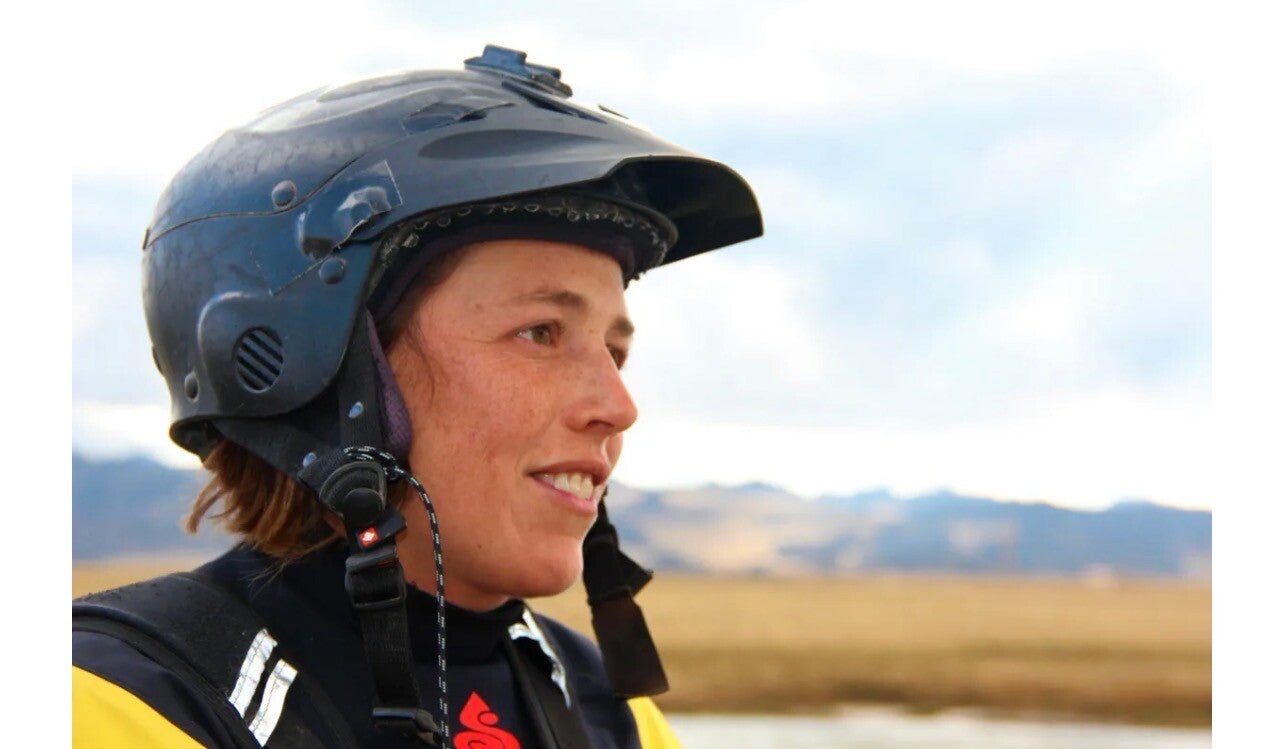
By Brad De Young | West Michigan Kayaking Club | The Kayaker’s Journal
Some paddlers explore rivers. Others make the river itself their expedition.
There are adventures that test your skills.
There are adventures that test your endurance.
And then there are adventures that test everything you believe you are capable of doing.
For Darcy Gaechter, one of those adventures was the Amazon.
In 2013, Gaechter became the first woman to kayak the Amazon River from its source to the Atlantic Ocean, completing a journey of approximately 4,300 miles in 148 days. (Darcy Gaechter)
It was an accomplishment that placed her among the most accomplished expedition kayakers of her generation.
But the Amazon wasn’t where her story began.
It was the culmination of years spent learning how to read rivers, survive difficult water, lead expeditions and keep paddling when circumstances became uncomfortable—or downright frightening.
And that’s what makes Darcy Gaechter’s story so compelling.
She didn’t simply decide one day to paddle the Amazon.
She built a life that eventually made an expedition like that possible.
From Colorado to the River
Darcy Gaechter grew up in Colorado, surrounded by mountains and outdoor recreation.
Her introduction to whitewater came shortly after high school, when she took a summer job as a raft guide.
Kayaking wasn’t initially the plan.
But the people around her were kayakers.
And she wanted to learn.
The beginning wasn’t particularly glamorous.
In interviews, Gaechter has described an early period filled with frustration, swimming and trying to figure out skills that other paddlers weren’t necessarily taking the time to teach her.
She kept going.
That decision would change her life.
Over the following decades, kayaking became far more than a recreational activity.
It became her profession, her classroom, her method of exploration and eventually the foundation for one of the most extraordinary river expeditions ever undertaken by a woman.
Her biography says she eventually participated in and led kayaking expeditions in 18 countries, while also working as a kayak, raft and adventure-travel guide. (Darcy Gaechter)
Becoming an Expedition Kayaker
The Amazon expedition didn’t happen because Gaechter was looking for an easy challenge.
By the time she reached the Amazon, she had already developed extensive experience in difficult whitewater.
She competed in races.
She guided.
She led expeditions.
She traveled internationally.
She learned how to operate in remote environments.
And she developed the judgment necessary to make decisions when conditions were changing.
That distinction matters.
Expedition kayaking isn’t simply about being able to paddle a difficult rapid.
It requires a combination of:
Technical skill.
Endurance.
Navigation.
Logistics.
Risk management.
Leadership.
Teamwork.
Adaptability.
And the ability to continue making good decisions after you’re exhausted.
Gaechter had spent years developing those abilities.
Then came an opportunity to attempt something extraordinary.
The Dream of the Amazon
The idea for the expedition came from British paddler David “Midge” Midgley.
Midgley had spent years preparing for the possibility of kayaking the Amazon from its source to the sea.
He eventually connected with Gaechter and her husband and paddling partner, Don Beveridge, through their guiding operation in Ecuador.
The expedition team came together around an enormous objective:
Kayak the entire Amazon River.
Not simply the easy sections.
Not a supported tourist journey.
Not a trip that bypassed the difficult whitewater.
The goal was to follow the river from its origins in the Peruvian Andes all the way to the Atlantic Ocean.
The expedition website records that the team planned the journey years before actually launching. (Kayak the Amazon)
Preparation mattered.
Because the Amazon was not going to give them many second chances.
4,300 Miles of River
In 2013, Gaechter, Midgley and Beveridge began the expedition.
The route stretched approximately 4,300 miles.
It took 148 days.
And it carried them through an extraordinary variety of environments.
The river began high in the Andes of Peru.
From there, the expedition descended through increasingly larger waterways before eventually reaching the enormous Amazon basin and the Atlantic Ocean.
Along the way came some of the most difficult whitewater of the expedition.
There were remote stretches where help was far away.
There were long days of paddling.
There were logistical problems.
There were physical and emotional challenges.
And there were moments when simply staying focused mattered as much as technical kayaking ability.
Paddling Magazine described the journey as a 4,259-mile expedition completed in 148 days. (Paddling Magazine)
The expedition team’s own account places the overall distance at approximately 4,300 miles. (Kayak the Amazon)
Either way, the scale is staggering.
The Whitewater
One of the most remarkable aspects of Gaechter’s Amazon expedition is that the team didn’t simply float downstream.
The upper Amazon presented serious whitewater.
Some sections were difficult enough that previous expeditions had used different craft or bypassed sections of the river.
Gaechter’s team wanted to kayak the river continuously.
That meant confronting the river on its own terms.
Gaechter brought decades of whitewater experience to a river that could be unpredictable, remote and powerful.
And there was another twist.
Despite her extraordinary whitewater background, Gaechter later explained that the Amazon expedition was only her second time sea kayaking.
The expedition gave her approximately 123 days of sea-kayaking experience in the course of completing the journey. (Paddling The Blue Podcast)
That’s an incredible detail.
One of the world’s elite whitewater kayakers was learning another side of kayaking while attempting one of the longest river expeditions imaginable.
More Than a River
The Amazon isn’t simply a river.
It’s an entire world.
The expedition passed through remote communities and environments where the river is central to everyday life.
The team had to deal with conditions far removed from the familiar rivers of North America.
There were concerns about wildlife.
There were questions of food and resupply.
There were navigation challenges.
There were political and security concerns.
And there were sections of the journey where the expedition team’s isolation became a significant factor.
The book Amazon Woman describes encounters with dangerous whitewater as well as threats involving armed groups and other hazards along the route. (Simon & Schuster)
This was not simply a long paddle.
It was an expedition through one of the most complicated environments on Earth.
The First Woman
When Darcy Gaechter reached the Atlantic, she had accomplished something that no woman had done before.
She had kayaked the Amazon from source to sea.
The expedition also established several other distinctions.
According to the expedition’s own records, Gaechter became the first woman to complete the entire Amazon by kayak, while the team completed what it described as the first kayak-only descent of the river. (Kayak the Amazon)
But Gaechter’s accomplishment wasn’t simply about being first.
The importance of the expedition went beyond the record.
For decades, women had been proving themselves in outdoor sports that were often portrayed as male-dominated.
Gaechter became another example of what happens when someone refuses to accept that certain adventures belong only to somebody else.
Her own website describes her work as an effort to inspire people of different backgrounds and ages to challenge expectations. (Darcy Gaechter)
When the River Becomes the Teacher
One of the most interesting things about Gaechter’s story is that the Amazon wasn’t simply a test of physical endurance.
It changed her.
In interviews about the expedition, she has talked about the importance of mindset and the way small changes in thinking can affect how a person handles difficult circumstances.
That may be one of the most universal lessons in expedition paddling.
A river doesn’t care how confident you were when you launched.
Eventually, something goes wrong.
You’re tired.
The weather changes.
The water gets bigger.
The route becomes confusing.
Your body hurts.
The next campsite is farther away than expected.
And suddenly the expedition becomes less about the dream you imagined and more about the next decision in front of you.
That’s where experience matters.
And that’s where mindset matters.
Amazon Woman
Gaechter eventually turned her expedition into the book Amazon Woman: Facing Fears, Chasing Dreams, and a Quest to Kayak the World’s Largest River from Source to Sea.
Published in 2020, the book chronicles the expedition and the years of preparation behind it. (Simon & Schuster)
But it is more than an expedition log.
It’s also the story of what happens when a person decides to pursue a goal that appears unreasonable from the outside.
The Amazon becomes the setting.
The deeper story is about fear, preparation, perseverance and refusing to let other people’s expectations determine the size of your life.
A Career Beyond the Amazon
It would be easy to define Darcy Gaechter entirely by the Amazon.
But that would actually undersell her career.
The Amazon was one expedition.
Her paddling life extends far beyond it.
She has raced whitewater around the world.
She has led expeditions.
She has guided paddlers.
She has worked in Ecuador.
She has traveled extensively through the international whitewater community.
And she has spent years helping other paddlers experience difficult rivers.
Her professional life has included operating Small World Adventures, a whitewater guiding company in Ecuador. (Darcy Gaechter)
In other words, she didn’t simply complete one incredible expedition and disappear.
She continued building a life around rivers.
From Expedition Paddler to River Advocate
There is another important part of Gaechter’s story.
Her connection to rivers eventually expanded beyond paddling them.
She has supported river-conservation work, including involvement with the Ecuadorian Rivers Institute.
Her background in environmental history also influenced her writing and conservation work. (Darcy Gaechter)
That’s something Michigan paddlers should understand.
The more time you spend on rivers, the harder it becomes to see them simply as recreational resources.
You begin noticing the water quality.
The fish.
The shoreline.
The dams.
The development.
The changes in flow.
The communities that depend upon the river.
Paddling creates a relationship with waterways.
And relationships often create responsibility.
What Michigan Paddlers Can Learn From Darcy Gaechter
Darcy Gaechter’s story might seem impossibly far removed from a Michigan river.
The Amazon is thousands of miles away.
The water is different.
The climate is different.
The wildlife is different.
The risks are different.
But the fundamental lessons are surprisingly familiar.
Preparation matters.
Skills matter.
Good partners matter.
Endurance matters.
Knowing when to push and when to reassess matters.
And perhaps most importantly:
Adventure begins when you decide that the boundaries other people see aren’t necessarily your boundaries.
You don’t have to paddle 4,300 miles to understand that.
You can discover it on a 20-mile Michigan river trip.
You can discover it during a difficult portage.
You can discover it when you’re exhausted but still have another ten miles to go.
You can discover it when the weather changes and your carefully planned trip becomes something completely different.
Every serious paddler eventually discovers some version of the same truth.
The river teaches you.
A Different Kind of Michigan Connection
Darcy Gaechter isn’t a Michigan-born paddling legend in the same historical sense as Hugh Heward or Verlen Kruger.
Her story comes from the wider expedition-kayaking world.
But that’s exactly why she belongs in a modern Michigan Paddling Legends conversation.
Michigan is one of America’s great paddling states.
We have the Great Lakes.
Thousands of inland lakes.
Major rivers.
Whitewater.
Coastline.
Remote wilderness.
And a paddling culture that has produced racers, instructors, explorers, expedition leaders and conservationists.
Michigan paddlers don’t exist in isolation.
We are part of a much larger paddling community.
The stories of people like Darcy Gaechter remind us that the skills developed on our local rivers can eventually take a paddler anywhere.
The next river might be the Grand.
The Muskegon.
The Manistee.
The Au Sable.
The Jordan.
The Thornapple.
Or, someday, something halfway around the world.
The Spirit of Exploration
At West Michigan Kayaking Club, we believe paddling should be about more than simply getting from one launch to another.
It’s about exploration.
It’s about learning.
It’s about becoming more capable.
It’s about discovering places you can’t reach from a highway.
And it’s about building the confidence to take on bigger adventures.
That’s the connection between Darcy Gaechter and the paddlers of Michigan.
She didn’t start with the Amazon.
She started with a raft-guide job.
She learned.
She struggled.
She kept paddling.
She developed her skills.
She traveled.
She guided.
She explored.
And eventually she found herself standing at the beginning of one of the greatest river journeys imaginable.
That progression is something every paddler can understand.
From Michigan Rivers to the World’s Great Waterways
Hugh Heward crossed Michigan by canoe more than two centuries ago.
Verlen Kruger turned expedition canoeing into a lifetime pursuit.
Steve Landick helped complete one of the greatest long-distance canoe journeys ever undertaken.
And Darcy Gaechter showed what modern expedition kayaking could look like when preparation, technical skill and determination come together.
Different people.
Different rivers.
Different eras.
But the same basic idea.
Go farther.
Learn more.
Explore what is beyond the next bend.
Because the greatest paddling adventures rarely begin with knowing exactly where the journey will end.
They begin with a willingness to launch.
And once you launch, the river has a way of changing you.
The Kayaker’s Journal
Michigan Paddling Legends explores the people, expeditions and defining moments that helped shape the history of kayaking, canoeing and paddle sports.
At West Michigan Kayaking Club, we’re continuing that tradition here in Michigan—exploring rivers, building skills, taking on longer expeditions and encouraging paddlers to experience the outdoors at a deeper level.
Our club is free.
No dues.
No membership fees.
No donations.
Just a community of paddlers who want more than a casual float.
Kayak. Canoe. SUP. Hike. Explore.
Wild Rivers. Rugged Trails. Real Adventure.
Brad De Young
Founder | West Michigan Kayaking Club
The Kayaker’s Journal
Learn More
Official West Michigan Kayaking Club Facebook Group
Follow Darcy Gaechter’s Story
Darcy Gaechter’s official website
Amazon Woman — Simon & Schuster
#WestMichiganKayakingClub #MichiganPaddlingLegends #DarcyGaechter #AmazonWoman #MichiganKayaking #MichiganPaddling #KayakingMichigan #ExpeditionKayaking #WhitewaterKayaking #TheKayakersJournal