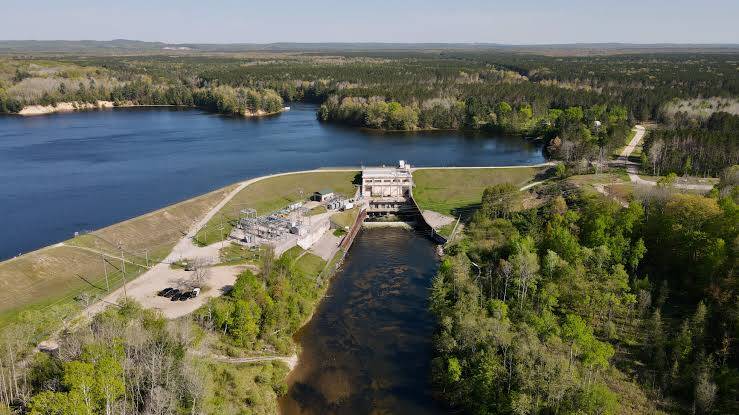
For more than a hundred years, Consumers Energy has drawn power and profit from the rivers of Michigan. The dams that made that extraction possible—gray concrete walls and earthen embankments thrown across the Manistee, Au Sable, Muskegon and other waterways—were engineered in an era when rivers were treated as industrial resources rather than living systems. Today those same structures stand as liabilities: aging, costly, ecologically damaging, and increasingly dangerous under the stress of heavier rains and higher peak flows. The company’s response has been consistent with its long record. Rather than accept responsibility for bringing the dams to modern safety standards or restoring the rivers they obstruct, Consumers has sought to sell them for a dollar apiece to a private equity vehicle, locking ratepayers into an expensive long-term power contract while transferring the hard problems of maintenance, liability, and eventual decommissioning elsewhere.
Nowhere is the pattern clearer than at Hodenpyl Dam on the Manistee River.
Spring Floods, Damaged Infrastructure, and a Controlled Crisis
In April 2026, extreme runoff from rain and melting snow pushed northern Michigan rivers to historic levels. At Hodenpyl, the high water left visible consequences in the tailrace: compromised sheet piling, sinkholes, and evidence of a possible leak in a submerged retaining wall. Consumers Energy described the damage in internal communications with regulators and later acknowledged the need for underwater inspection. The company has insisted there is no immediate threat to public safety and that the dam and its sister structures operated within design parameters during the floods. It has also noted that the two generating units at Hodenpyl were offline, limiting the ability to pass water through the powerhouse and forcing reliance on the spillway.
The practical result is that any thorough inspection of the damaged area requires temporarily reducing or interrupting flow. Doing the work under full turbulent discharge would place divers in unacceptable danger. Consumers therefore planned intervals of curtailed or zero flow, most recently targeting the week of September 21, 2026. State officials and river advocates reacted with alarm. The Michigan Department of Natural Resources warned that even short dewatering events could kill large numbers of stocked trout and disrupt the aquatic community downstream. Conservation groups argued that alternatives had not been fully exhausted and that the river—already stressed—should not be sacrificed for the convenience of an aging industrial asset.
This sequence is revealing. The damage is real. The inspection need is real. The ecological risk of the chosen method is also real. What is missing is any public commitment by Consumers to treat the episode as a signal that the dam’s useful life is ending. Instead, the company frames the work as routine maintenance while simultaneously advancing a sale that would move the long-term burden of the structure off its books.
Voices from the River
Those who spend the most time on the water see the risks with particular clarity. “Anyone who believes these dams remain safe is wearing blinders,” said a cofounder of the West Michigan Kayaking Club. “Consumers Energy has done little more than attempt to transfer the responsibility. These structures are incredibly dangerous, have long outlived their engineered lifespan, and must be removed.”
The sentiment is widely shared among paddlers, anglers, and river advocates who navigate the Manistee and its sister rivers. They point to the combination of advanced age, documented flood damage, offline generating units, and the company’s simultaneous push to sell the assets as evidence that safety is being managed for appearance and liability transfer rather than genuine long-term protection of the public and the ecosystem.
Follow the West Michigan Kayaking Club
West Michigan Kayaking Club
Wild rivers. Rugged trails. Real adventure.
An active paddling community based in Grand Rapids, the club organizes group river adventures across Michigan’s waterways—from scenic day trips to longer expeditions on rivers including the Manistee. Membership and events are open to paddlers of all experience levels who want more time outdoors exploring free-flowing water.
Website: https://www.westmichigankayakingclub.online/
Facebook: https://www.facebook.com/groups/749998724166493/
A Fleet Past Its Design Life
Hodenpyl is not an outlier. Consumers owns thirteen hydroelectric dams across Michigan, most of them constructed between the 1910s and 1930s. They produce roughly one percent of the company’s electricity at a cost far higher than alternative sources. Their federal licenses begin expiring in the 2030s. Many carry high-hazard classifications, meaning failure would threaten lives and property downstream. They block fish passage, warm the water, trap sediment, and fragment ecosystems that once supported robust runs of migratory species. The impoundments they create are valued by some shoreline property owners and local tourism businesses, yet those economic benefits are private and localized while the ecological and safety risks are public and long-term.
The engineering reality is straightforward. Concrete and earthen structures of this age require continuous, expensive investment to remain safe under modern hydrologic conditions. Climate-driven increases in extreme precipitation place greater stress on spillways, foundations, and embankments. Deferred maintenance compounds the problem. When the cost of keeping the dams safe exceeds the value of the power they generate, the rational corporate response—absent external pressure—is to exit. That is precisely the path Consumers has chosen.
The Sale: Liability Transfer Dressed as Customer Benefit
In 2025 Consumers announced an agreement to sell all thirteen dams to Confluence Hydro, a newly formed subsidiary of Maryland private-equity firm Hull Street Energy, for one dollar each. The companion power-purchase agreement would require Consumers’ ratepayers to buy the dams’ output for thirty years at roughly twice the prevailing market price for comparable energy, with annual escalators. The utility presented the arrangement as the lowest-cost option for customers, arguing that it avoids both the capital expenditures required to keep the dams and the still-larger costs of decommissioning them.
An administrative law judge who reviewed the record recommended that the Michigan Public Service Commission reject the transaction. The judge found the deal inconsistent with the public interest, highly problematic, and unreasonable. Central to that conclusion was the absence of durable, enforceable commitments ensuring the new owner would fund the full lifecycle needs of high-hazard infrastructure. Private equity answers to investors who expect returns on defined timelines. Long-lived, low-margin, high-liability assets such as century-old dams do not fit that model comfortably. The risk that an individual dam could be placed in a thinly capitalized limited-liability company, allowed to deteriorate, and then abandoned to the state or ratepayers is not theoretical. Michigan has already lived through private-dam failures and near-failures that left taxpayers and communities holding the costs.
Governor Gretchen Whitmer formally opposed the sale, citing the 2020 Midland-area dam failures, problems at other privately held structures, and the inadequate safeguards in the Consumers proposal. The Attorney General’s office and the Department of Natural Resources raised parallel objections. Conservation organizations argued that the transaction would lock in the ecological harm of the dams for another generation while creating a new layer of financial risk for the public.
Consumers and the prospective buyer have responded that the elevated power price provides the necessary incentive for maintenance and that the buyer brings experience operating hydro assets. Those claims have not persuaded the growing coalition of opponents. The structure of the deal still transfers the hardest problems—capital-intensive safety upgrades, relicensing under stricter environmental standards, and eventual removal—away from the regulated utility that has owned and operated the dams for decades.
A Century of Extraction
Consumers Energy and its predecessors have generated returns for investors by selling electricity to Michigan residents for more than a hundred years. The hydro fleet was an early and important part of that business. Over time the relative contribution of the dams shrank as coal, natural gas, nuclear, and now renewable generation scaled. The environmental and safety externalities of the dams did not shrink. Fish populations declined. River temperatures rose. Sediment regimes changed. The public continued to bear those costs while the company collected regulated returns.
When the dams became net liabilities rather than assets, the corporate instinct was not to remediate or remove them at shareholder expense. It was to find a buyer willing to take title for a nominal sum and to secure a long-term revenue stream from ratepayers that would make the transfer workable for private capital. That is not stewardship. It is the logical end-stage of an extractive relationship with the rivers.
The alternative—full removal and river restoration—would be expensive in the short term. It would also be finite. Once the concrete is gone and the river is free to re-establish natural gradients, floodplains, and habitat, the ongoing liability ends. Fish passage is restored. Water temperatures moderate. Sediment moves. The catastrophic risk of dam failure disappears. The Manistee River, already a prized trout fishery and recreational corridor through national forest lands, would become a continuous free-flowing system rather than a series of industrial ponds interrupted by aging walls.
No serious financial analysis shows that private capital will choose to invest the sums required to modernize these dams to contemporary safety and environmental standards when the power they produce is marginal and the alternative of eventual public bailout remains available. Historical patterns of private infrastructure ownership under financial pressure point the other direction: minimize capital outlays, extract available cash, and leave residual problems for someone else.
The Only Durable Solution
There is no credible scenario in which these dams become profitable generating assets again under private ownership while meeting modern safety and ecological requirements. The power is too little and too expensive. The capital needs are too large. The environmental damage is ongoing. The failure risk, while not precisely quantifiable year by year, is real and growing with climate extremes.
Consumers Energy built and operated these structures, collected the returns they produced, and now seeks to walk away from the consequences. That sequence is unacceptable. The company should be required to fund the safe removal of the dams it no longer wants, the restoration of the river channels and floodplains, and the mitigation of residual contamination or habitat damage. Ratepayers should not be forced into a thirty-year premium power contract so that private equity can warehouse the problem. Taxpayers should not be left as the residual risk-bearers when an under-capitalized owner eventually defaults.
The emergency inspections, the flow interruptions, the contested sale, and the political opposition are not isolated events. They are symptoms of a deeper mismatch between twentieth-century industrial infrastructure and twenty-first-century ecological and safety realities. The Manistee River and the other waters still captive to these dams deserve better than managed decline and liability transfer. They deserve to run free.
The dams have outlived their purpose. It is time to take them out.