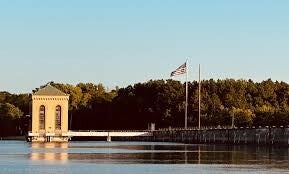
Consumers Energy seeks to defer major spillway project as Michigan DNR warns that further delays could create an unacceptable level of risk
By Staff Writer
September 3, 2026
For nearly a century, Hardy Dam has held back the Muskegon River, creating a 4,000-acre reservoir that has become a centerpiece of recreation and tourism in Newaygo and Mecosta counties.
But behind the boating, fishing and waterfront development is a far more consequential question:
How much longer can Michigan rely on a 95-year-old dam whose existing spillway does not meet the latest federal flood standards—and what happens if the work needed to address that deficiency continues to be delayed?
The answer is not simply a question of whether Hardy Dam is about to fail. There is no public evidence that an imminent failure is occurring.
The concern is more fundamental.
Federal regulators have determined that Hardy’s existing spillway is inadequate for the revised Probable Maximum Flood—the extreme flood scenario used in dam-safety planning. Consumers Energy subsequently identified a massive auxiliary-spillway replacement, along with other work at the dam, as a critical need.
The estimated price tag: approximately $350 million.
And now, after years of planning, Consumers Energy has asked federal regulators to postpone the beginning of that work until December 31, 2028.
Michigan’s Department of Natural Resources has objected.
The DNR has warned that additional delays could create an unacceptable level of risk unless the interim measures being used to manage Hardy’s flood risk are demonstrated to be adequate. (Big Rapids Pioneer)
That puts Hardy Dam at the center of a larger question facing Michigan:
When does maintaining an aging dam become more dangerous—and more expensive—than confronting the possibility of removing it?
A dam built in 1931
Hardy Dam was constructed in 1931 by Consumers Power Company, now Consumers Energy.
The resulting Hardy Dam Pond covers approximately 3,971 acres and inundates roughly 25 miles of the Muskegon River. The dam is regulated by the Federal Energy Regulatory Commission, and its current operating license expires in 2034. (Michigan)
The Michigan DNR recognizes the importance of the Hardy impoundment for recreation and fisheries.
But the agency also acknowledges a fundamental problem with hydroelectric dams: they alter the natural river environment and can limit resource-management options.
The DNR says hydroelectric facilities can adversely affect the riverine environment and aquatic ecosystems, and that its role includes recommending measures to mitigate those impacts and recommending license conditions to FERC. (Michigan)
Hardy is therefore not simply a power plant.
It is a piece of aging infrastructure sitting across one of Michigan’s major rivers.
And that infrastructure carries consequences both upstream and downstream.
The spillway problem
The most important issue at Hardy is not simply its age.
It is its ability to safely handle an extreme flood.
According to the Michigan DNR’s April 2026 filing with FERC, a 2014 inspection identified a potential failure under the design-basis storm scenario and concluded that the existing spillway was inadequate to pass the revised Probable Maximum Flood.
The DNR also pointed to Consumers Energy’s own 2024 filing with Michigan regulators, in which the company characterized three components of the Hardy project as a “critical need”:
● replacement of the auxiliary spillway;
● replacement of the splash wall; and
● compaction of loose areas of the embankment crest.
The DNR’s conclusion was blunt: it was concerned that further delays could create an unacceptable level of risk at Hardy Dam. (Big Rapids Pioneer)
That is a significant distinction.
The issue is not that officials have declared Hardy Dam structurally unsound.
The issue is that the dam’s existing flood-control system does not meet the updated design requirement, and a major project was identified to correct it.
The $350 million delay
Consumers Energy originally proposed the Hardy auxiliary-spillway project in 2022, with construction initially expected to begin in 2023.
That schedule was subsequently pushed to 2025.
Then came the proposed sale of Consumers Energy’s 13 Michigan hydroelectric facilities.
On March 16, 2026, Consumers asked FERC to push the Hardy construction deadline again—this time to December 31, 2028.
Consumers said the requested delay was necessary because regulatory approvals for the project had not been completed and because the proposed sale of the hydroelectric fleet remained under state and federal review.
The company argued that allowing a new owner to coordinate the project would be more practical. (Big Rapids Pioneer)
But that explanation raises another question:
What happens to public safety when a major dam-safety project becomes intertwined with an ownership transaction?
The DNR’s concern is that the answer cannot simply be: wait.
The interim solution
Consumers Energy says it has implemented interim risk-reduction measures while the larger project remains unresolved.
The company has argued that improvements made to Hardy allow it to pass a similar flood without activating the auxiliary spillway.
Consumers has also used reservoir-management measures to provide additional flood-storage capacity.
Those measures matter.
But the DNR has specifically questioned whether interim measures are sufficient to justify extending the construction timeline.
In its April filing, the DNR asked FERC to evaluate the adequacy of the existing interim risk-reduction measures and, if necessary, require additional protections before allowing the project to be delayed. (Big Rapids Pioneer)
That is perhaps the most important fact in the entire Hardy Dam debate.
The question isn’t whether interim measures exist. The question is whether they provide enough protection for as long as the permanent solution is postponed.
What happens downstream?
Hardy Dam is classified as a high-hazard facility because of the potential consequences of a failure.
That classification does not mean failure is expected.
It means that if a failure were to occur, the consequences could be severe because of the people, infrastructure and property downstream.
A historical flood scenario has demonstrated just how consequential Hardy could be.
Reporting on the dam has cited a 1986 flood in which Hardy and downstream Croton Dam came dangerously close to being overwhelmed. A modeled failure scenario has estimated a flood wave capable of traveling downstream toward Muskegon.
Consumers disputes the suggestion that conditions today are comparable to 1986, saying subsequent improvements have increased Hardy’s ability to handle extreme flows. (Bridge Michigan)
That disagreement deserves scrutiny—not political spin.
The public deserves to know exactly what changed, what remains deficient, what the interim protections accomplish, and what risks remain during the proposed delay.
The hidden problem: the public can’t see everything
There is another complication.
Much of the detailed safety information concerning federally regulated dams is not publicly available because of federal restrictions governing sensitive critical-energy infrastructure information.
That means the public cannot independently review every engineering detail behind Hardy’s current risk assessment.
What is public, however, is enough to establish several important facts:
The dam is nearly a century old.
The existing spillway does not meet the revised flood standard identified by regulators.
Consumers Energy identified major Hardy improvements as a critical need.
The required spillway project has been estimated at approximately $350 million.
Consumers Energy has requested that construction be delayed until the end of 2028.
Michigan DNR has objected to the delay and asked FERC to ensure interim risk-reduction measures are adequate. (Big Rapids Pioneer)
Those facts alone warrant public scrutiny.
And then there is the sale
Consumers Energy is seeking to sell its 13 hydroelectric dams to Confluence Hydro, an affiliate of Hull Street Energy.
The proposed transaction would transfer responsibility for operating and maintaining Hardy to the new owner.
Confluence has publicly stated that it intends to continue the Hardy upgrades and has said it reviewed Consumers’ plans for the auxiliary spillway, embankment work and splash wall.
But Michigan DNR testimony before state regulators raises a larger concern.
Lucas Trumble, writing in testimony submitted in the Michigan Public Service Commission’s dam-sale proceeding, said a new owner would need access to substantial capital to complete planned safety upgrades—including the Hardy auxiliary spillway project, which he described as costing hundreds of millions of dollars.
His concern was whether financing and future electricity revenues would allow the new owner to complete all planned safety improvements in a timely manner, or whether maintenance could be deferred until adequate funding becomes available. (Open MPSC)
That is not a prediction that Confluence will fail.
It is a warning about the economics of aging infrastructure.
A dam does not become cheaper to maintain because ownership changes.
Concrete continues to age.
Steel continues to corrode.
Floods continue to occur.
And engineering standards continue to evolve.
Michigan has already learned this lesson
Michigan does not have to imagine what happens when dam infrastructure, ownership and financial responsibility collide.
The 2020 Edenville Dam failure demonstrated the consequences of inadequate dam infrastructure and insufficient investment.
That dam was not owned by Consumers Energy, and it would be inaccurate to suggest otherwise.
But the disaster changed the state’s understanding of aging-dam risk.
Michigan EGLE now acknowledges that many dams have accumulated decades of deferred maintenance and that some owners lack the financial capacity to address major repairs.
The agency has described aging dams as a growing statewide safety problem. (Michigan)
The DNR has reached a similar conclusion from a different direction.
In its capital-outlay planning documents, the agency says dam removal can eliminate perpetual maintenance costs and, for dams in poor condition, eliminate the risk to downstream public safety and property posed by catastrophic failure. (Michigan)
That does not mean DNR is calling for Hardy Dam to be removed.
It isn’t.
But it does establish an important principle:
Michigan’s own natural-resource agency recognizes that removal can sometimes be the safer long-term alternative to maintaining aging dams indefinitely.
The river pays a price, too
The Hardy debate is also bigger than concrete, spillways and engineering reports.
It is about the Muskegon River itself.
The DNR’s fisheries documentation identifies Hardy as one of four large dams on the Muskegon River mainstem.
Downstream, Croton Dam remains the first major barrier preventing migratory fish from Lake Michigan and Muskegon Lake from moving farther upstream. (Michigan)
The dams have transformed sections of a free-flowing river into reservoirs.
Those reservoirs support recreation, waterfront communities and fisheries.
But they also change water temperature, sediment movement, aquatic habitat and fish passage.
The DNR itself says hydroelectric facilities can adversely affect riverine and aquatic ecosystems. (Michigan)
So Michigan faces two competing realities.
Hardy Dam has become an important recreational resource.
But maintaining that reservoir requires maintaining a nearly century-old piece of infrastructure—and maintaining it to modern safety standards could cost hundreds of millions of dollars.
The question regulators cannot avoid
Consumers Energy has said the dam can be operated safely.
Confluence Hydro says it intends to make the necessary investments.
The DNR says the delay creates concern and wants the interim protections examined before additional time is granted.
Those positions cannot all simply be brushed aside.
The central question for FERC and Michigan regulators should therefore be straightforward:
Is postponing a project that has been identified as a critical need consistent with the state’s and federal government’s obligation to protect people downstream?
And beyond that:
Is spending hundreds of millions of dollars to perpetually maintain a 95-year-old dam the best long-term investment for Michigan’s citizens, taxpayers, anglers and the Muskegon River?
Those are different questions.
The first is about immediate risk.
The second is about the future.
A decision measured in decades—not election cycles
Hardy Dam’s current situation should not be reduced to an argument between people who like reservoirs and people who want free-flowing rivers.
The stakes are much higher.
A dam of this size cannot be treated like an ordinary piece of private property.
Its failure could affect people who never agreed to assume the risk.
Its maintenance can cost hundreds of millions of dollars.
Its reservoir has become economically important to communities around it.
And its presence fundamentally alters the Muskegon River.
The DNR has already told federal regulators that it is concerned further delay could pose an unacceptable level of risk.
That warning deserves more than a footnote in a regulatory filing.
It deserves public attention.
Because the real issue at Hardy Dam is not whether the structure will collapse tomorrow.
There is no evidence to say that.
The issue is whether Michigan should continue postponing a known, enormously expensive flood-control project while ownership of the dam changes hands—and whether the state should spend hundreds of millions of dollars preserving an aging structure when permanent removal could ultimately eliminate both the structural risk and the perpetual maintenance obligation.
Hardy Dam may not be failing today. But Michigan is being forced to decide what it is willing to risk, what it is willing to spend, and how long it is willing to keep betting on an aging dam before confronting the harder question:
Is the safest future for the Muskegon River a repaired Hardy Dam—or no dam at all?
SOURCES & DOCUMENTATION
Michigan Department of Natural Resources — Dams and Hydroelectric Facilities
The DNR explains its role in FERC-regulated hydroelectric projects and acknowledges that hydroelectric facilities can adversely affect riverine environments and aquatic ecosystems. (Michigan)
Michigan DNR — Hardy Dam Pond Fisheries Report
Documents the 1931 construction of Hardy Dam, its approximately 3,971-acre impoundment, Consumers Energy ownership and FERC regulation. (Michigan)
Michigan DNR — April 2026 filing regarding Hardy Dam
Documents the DNR’s opposition to further delay and its concerns regarding the adequacy of interim risk-reduction measures. (Big Rapids Pioneer)
Michigan Public Service Commission — U-21985 testimony
Documents concerns about whether a new owner will have sufficient financing to complete planned dam-safety improvements, including the Hardy auxiliary spillway project. (Open MPSC)
Bridge Michigan — Hardy Dam spillway investigation
Documents Consumers Energy’s $350 million estimate, the requested delay and the company’s position regarding Hardy’s current ability to handle extreme floods. (Bridge Michigan)
Federal Energy Regulatory Commission — Dam Safety Program
FERC explains that aging dams require continuing inspection and oversight and that dam-safety evaluations consider potential failure modes and consequences. (Federal Energy Regulatory Commission)
Michigan Department of Natural Resources — Dam Removal Planning
DNR documents the potential safety, financial and ecological benefits of removing aging dams when continued maintenance is not justified. (Michigan)
West Michigan Kayaking Club
This investigation is part of an ongoing effort to examine the condition, safety, environmental impact and long-term future of Michigan’s dams and rivers.
West Michigan Kayaking Club is a volunteer outdoor-adventure community focused on exploring and protecting Michigan’s rivers through kayaking, hiking and wilderness adventure.
Visit the West Michigan Kayaking Club
Wild Rivers. Rugged Trails. Real Adventure.
#westmichigankayakingclub #MuskegonRiver #HardyDam #MichiganRivers