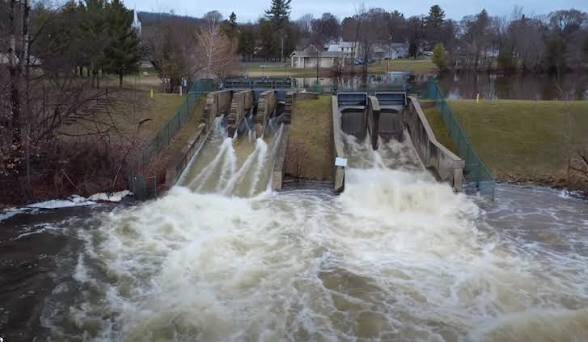
Michigan’s Dams Were Built for Another Century. Now Lawmakers Are Trying to Fix the System
By Brad De Young, Co-Founder, West Michigan Kayaking Club
Michigan Watershed Watch
Michigan has thousands of dams.
Some protect communities. Some generate power. Some provide recreational lakes. Others have outlived the purpose for which they were built.
And increasingly, Michigan is being forced to confront a difficult question:
Who is responsible when an aging dam becomes a threat—and how long should taxpayers and downstream communities be expected to live with that risk?
The question is no longer theoretical.
In 2020, the Edenville Dam failed after heavy rainfall, sending a wall of water downstream and contributing to the failure of the Sanford Dam. Thousands of people were evacuated, homes and businesses were damaged, and communities along the Tittabawassee River were left dealing with the consequences.
The disaster exposed more than failing infrastructure. It exposed the enormous consequences that can occur when aging dams, inadequate capacity, deferred maintenance and extreme weather collide.
Six years later, Michigan lawmakers are attempting to overhaul the state’s dam-safety regulations.
House Bill 5485, sponsored by Rep. Bill Schuette, would make extensive changes to Michigan’s existing dam-safety law, Part 315 of the Natural Resources and Environmental Protection Act. The legislation addresses inspections, safety requirements, owner responsibilities and other aspects of dam regulation. The Michigan Legislature records the bill as having received a motion to discharge the committee. A companion measure, Senate Bill 947, was introduced in July 2026.
But legislation raises a bigger question:
Are we fixing the problem—or simply becoming better at managing it?
Michigan’s dam inventory contains structures that were designed and constructed generations ago, under different engineering standards and different expectations about how rivers should be managed.
Many were built to generate electricity, power mills or create industrial water supplies. Others were constructed for flood control or to create reservoirs.
Today, some of those original purposes are gone.
Yet the dams remain.
And when a dam no longer provides a significant public benefit, the state and dam owners still face the same basic reality: the structure has to be maintained, repaired, replaced or removed.
There is no fifth option.
Ignoring the problem does not make the liability disappear. It simply allows the problem to grow.
The price of waiting
Dam failures can be extraordinarily expensive.
The immediate costs include destroyed homes, damaged roads and bridges, emergency evacuations and environmental damage.
But the costs continue long after the floodwaters recede.
Communities can lose businesses. Property values can be affected. Rivers can be altered. Sediment can move downstream. Fish and aquatic habitat can be disrupted.
And ultimately, taxpayers can find themselves paying for infrastructure they did not build and may not even need.
That is why Michigan’s dam debate cannot simply be about keeping every existing dam standing.
Dam safety and river restoration have to be part of the same conversation.
A structurally sound dam that provides an important public benefit may justify continued investment.
But what about a deteriorating dam that creates a significant hazard while providing little or no essential public benefit?
In those cases, spending millions of dollars to perpetually maintain an obsolete structure may not be the only option.
Sometimes the most responsible infrastructure decision is to take infrastructure out.
What happens to the river?
For paddlers, anglers, conservationists and communities that depend on healthy rivers, the consequences extend beyond engineering reports.
A dam can fundamentally change a river.
It can turn flowing water into a reservoir, alter water temperatures, trap sediment and interfere with fish movement. Removing a dam can, in appropriate circumstances, reconnect a river and restore some of the natural processes that existed before the structure was built.
That does not mean every dam should be removed.
It means every dam deserves an honest evaluation.
What purpose does it serve? What would it cost to repair? What would it cost to remove? What are the consequences of failure? Who is responsible for maintaining it? And what happens if the owner cannot or will not pay?
Those are not anti-dam questions.
They are basic public-policy questions.
Michigan has already seen the warning
The Edenville and Sanford failures should have permanently changed the way Michigan thinks about dam infrastructure.
The lesson is not simply that dams can fail.
The lesson is that waiting until failure is an incredibly expensive way to manage infrastructure.
Michigan now has an opportunity to establish a system that looks further ahead—one that identifies dangerous structures before catastrophe, holds owners accountable for maintaining them and recognizes that dam removal can sometimes be a legitimate infrastructure and river-restoration solution.
The debate should not be reduced to dams versus no dams.
The real question is whether Michigan is willing to make difficult decisions before the next failure makes those decisions for us.
Our rivers do not get a vote.
Downstream communities don’t get to choose when an aging dam fails.
And taxpayers should not have to discover the true cost of neglected infrastructure after the water is already rising.
Michigan has seen what happens when a dam system reaches its breaking point. The question now is whether we learned the lesson.
Brad De Young is co-founder of the West Michigan Kayaking Club and writes about Michigan rivers, paddling, conservation and watershed issues for Michigan Watershed Watch.