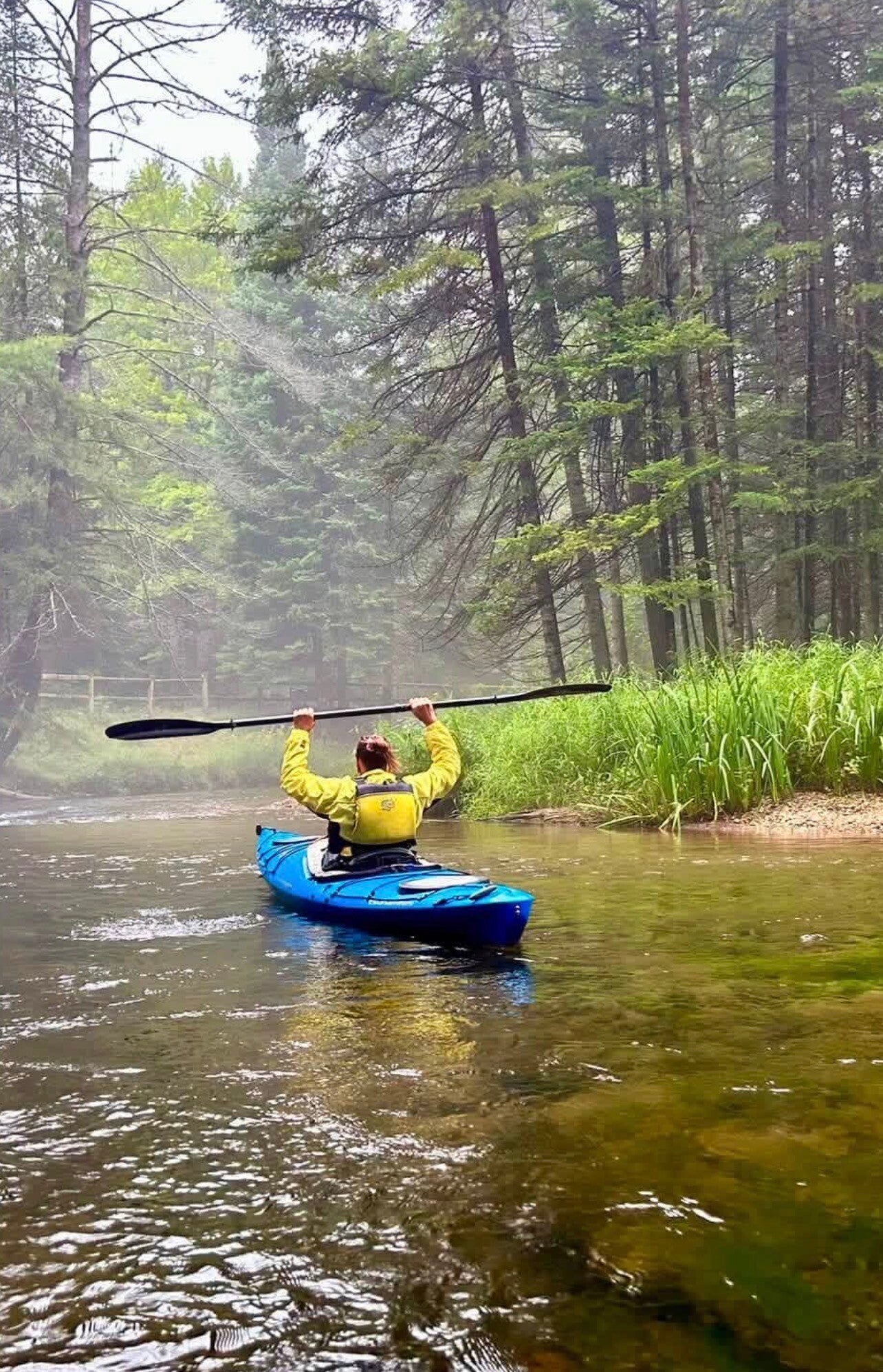
A West Michigan Kayaking Club Guide to Preparing for a Long-Distance River Day
By Brad De Young, Co-Founder of West Michigan Kayaking Club
Wild Rivers. Rugged Trails. Real Adventure.
Thirty miles changes the way you think about a river.
A five-mile paddle can be a relaxing afternoon. Ten miles starts to feel like a real outing. At 20 miles, preparation becomes important.
At 30 miles, the river becomes an expedition.
You’re no longer simply asking, “Can I paddle this far?”
You’re asking:
- Can I maintain a sustainable pace for hours?
- Can I eat and drink enough?
- Can I deal with changing weather and the real possibility of immersion?
- What happens if something goes wrong 20 miles from the launch?
That is the difference between a long paddle and a well-planned long-distance paddle.
At West Michigan Kayaking Club, we believe Michigan’s rivers are meant to be explored—but long-distance paddling requires preparation, judgment, and respect for the conditions.
This is how I approach a 30-mile Michigan river adventure.
30 Miles Is a Different Kind of Paddle
Thirty miles sounds simple on paper.
But distance alone doesn’t tell you how difficult a river will be.
A 30-mile downstream trip with favorable current can be dramatically different from a 30-mile trip on slow water, against the wind, through shallow sections, or around obstacles.
Your actual day is influenced by:
- Current speed
- Wind
- Water level
- Temperature (air and water)
- Boat type and load
- Portages and obstacles
- Stops and navigation
- Your paddling efficiency and experience
A paddler averaging 4 mph while moving can cover 30 miles in about 7½ hours of paddling time.
Add launching, landing, breaks, eating, navigation, obstacles, and unexpected delays, and the day becomes considerably longer.
Plan for the entire day—not just the mileage.
1. Choose the Right River
The first mistake is treating every 30-mile route as equivalent.
Michigan has everything from relatively gentle flatwater to rivers with significant current, technical features, fallen trees, and other hazards.
For a long-distance trip, research the entire route thoroughly:
- Exact launch and take-out points
- Actual paddling distance
- Obstacles, dams, dangerous structures, and mandatory portages
- Bridges, strainers, and logjams
- Possible exit points and nearest roads/access
- Cell coverage limitations
Don’t rely on a single map. Combine paper maps, satellite imagery, river guides, current conditions, local knowledge, and recent firsthand reports.
A route that looks easy on a map can look completely different at water level.
2. Understand Michigan Water Conditions
Michigan rivers change dramatically throughout the year.
- Spring high water brings faster current, floating debris, and very different river characteristics.
- Summer low water creates shallow sections, exposed obstacles, and frequent bottom contact.
- After heavy rain, a familiar river can become an entirely different river overnight.
Before launching, check all of the following:
- Recent rainfall
- Weather forecast (including wind, temperature, and severe weather potential)
- Current water levels and streamflow
- Water temperature
- Recent river reports from other paddlers
Reliable places to check Michigan water levels and streamflow:
- USGS National Water Dashboard (interactive map of real-time gauges across Michigan and the U.S.): https://dashboard.waterdata.usgs.gov/
- USGS Current Water Data for Michigan: https://waterdata.usgs.gov/mi/nwis/rt or the modern monitoring pages at waterdata.usgs.gov
- Snoflo Michigan River Levels & Streamflow (statewide overview with percent of normal): https://snoflo.org/flow/report/michigan
- RiverApp (easy river-by-river gauges for Grand, Kalamazoo, Muskegon, etc.): https://www.riverapp.net/
- West Michigan Kayaking Club Resources – Current Water Levels: https://www.westmichigankayakingclub.online/resources/current-water-levels
- U.S. Army Corps of Engineers Detroit District water data (especially useful for Great Lakes connecting waters and some regulated rivers)
Don’t confuse a favorable weather forecast with favorable river conditions. You need both.
3. Know Your Boat
A 30-mile paddle is not the place to discover that your kayak doesn’t fit you.
Your boat should be comfortable enough that you can spend many hours in it without significant pain or numbness.
Before the trip, thoroughly inspect:
- Hull, deck, hatches, and bulkheads
- Rudder or skeg
- Foot braces and seat
- Primary and spare paddle
- PFD
- Spray skirt (if used)
Keep your load organized and balanced. A poorly balanced boat makes a long day much harder.
4. Train Before You Attempt 30 Miles
Build distance gradually rather than jumping straight from shorter paddles.
A sensible progression might look like:
10 → 12 → 15 → 18 → 20 → 25 → 30 miles
Pay close attention to how your body responds—hands, wrists, forearms, shoulders, neck, lower back, hips, and legs.
A 30-mile day will expose weaknesses in both technique and equipment. Fix them on shorter trips first.
5. Learn to Paddle Efficiently
Long-distance paddling is about wasting less energy, not paddling harder.
- Engage your torso rather than relying only on your arms
- Maintain a relaxed grip
- Keep strokes smooth, controlled, and repeatable
A sustainable stroke repeated thousands of times is far more valuable than powerful strokes that exhaust you early. Many paddlers find the rhythm almost meditative once they settle in.
6. Establish Your Pace
Don’t start a 30-mile paddle as if you’re racing the first five miles.
The excitement of launching often causes people to go out too hard. Instead, settle into a pace you can sustain for seven, eight, or more hours.
For many experienced paddlers, 3–4+ mph is a useful planning range, but actual speed depends heavily on boat, current, wind, water conditions, and the paddler.
Save energy for the final miles.
7. Eat Before You’re Hungry & Stay Hydrated
Don’t wait until you’re exhausted to start eating or drinking.
Bring easily accessible foods you’ve already tested on shorter trips:
- Energy bars, sandwiches, fruit, trail mix, crackers, and other familiar high-energy options
Keep water (and any electrolytes) within easy reach rather than buried in a hatch.
How much you need varies with temperature, exertion, and individual factors—plan conservatively, especially on remote sections.
8. Break the 30 Miles Into Smaller Goals
Thirty miles can feel intimidating. Break it down:
- 0–5 miles: Find your rhythm
- 5–10 miles: Settle into a sustainable pace
- 10–15 miles: Check body, hydration, and equipment
- 15–20 miles: You’re halfway
- 20–25 miles: Maintain discipline
- 25–30 miles: Stay focused and finish safely
Small milestones make a big distance psychologically manageable.
9. Have an Exit Strategy
Plan for the possibility that the trip doesn’t go according to plan.
Identify in advance:
- Road crossings and public access points
- Possible take-outs and emergency exits
- Nearby communities
- Cell coverage gaps
- Weather shelters where applicable
Tell someone reliable where you’re going and when you expect to return.
If conditions deteriorate, don’t let the original mileage goal override safety. There is no prize for finishing 30 miles when the river or weather is telling you to stop.
10. Paddle With the Right People
Thirty miles is a long time on the water. Choose companions carefully.
For longer West Michigan Kayaking Club adventures, every participant is responsible for their own equipment, skills, fitness, and transportation.
Experienced groups often use positions such as Lead → Middle → Sweep to maintain contact and catch problems early.
11. Respect the River
Michigan’s rivers are beautiful, but they are not swimming pools.
Trees fall. Water levels change. Current changes. Weather changes. A river you’ve paddled ten times can behave differently on the eleventh trip.
Respect:
- Strainers and sweepers
- Dams and bridges
- Fast current
- Cold water
- Changing weather
If something looks wrong, stop and evaluate it. You don’t have to prove anything to the river.
12. Know When to Turn Around or Change Plans
One of the most important expedition skills is recognizing when the original plan needs to change—rising wind, rising water, a struggling paddler, an unexpected obstacle, or simply falling behind schedule.
Changing plans is not failure. It is good judgment. The river will still be there another day.
Weather, Water Temperature & Preparing for Immersion
Michigan weather can shift quickly, and water temperatures often lag behind air temperatures—especially in spring and fall.
Always check the forecast and current water temperature before you launch.
Prepare for the real possibility of immersion (capsizing, swimming, or unexpected time in the water):
- Dress for the water temperature, not just the air temperature.
- In cool or cold conditions, wear a wetsuit, drysuit, or appropriate insulating layers that retain warmth when wet.
- Carry a complete change of clothes in a properly sealed dry bag.
- Know the signs of cold-water shock and hypothermia, and have a plan to get warm quickly if someone ends up in the water.
- Practice self- and assisted-rescues appropriate to your boat and group before the big trip.
- If the water is cold and the forecast includes wind, rain, or dropping temperatures, seriously consider whether the 30-mile day is wise that particular day.
Favorable weather does not automatically mean favorable (or safe) immersion conditions. Plan for the worst reasonable scenario given the forecast and water temperature.
The Mental Side of 30 Miles
The physical challenge is only part of the story. Long-distance paddling is also a mental game.
There will likely be moments when 30 miles feels like a terrible idea. That’s normal.
When fatigue sets in, return to fundamentals:
Relax. Hydrate. Eat. Find your rhythm. Maintain your pace. Focus on the next mile.
The river has a way of teaching patience. Eventually the miles start disappearing behind you.
The Practical 30-Mile Gear Checklist
A 30-mile river day is long enough that small equipment problems can become big problems. Carry what you actually need, keep it organized, and know how to use it before you launch.
Boat & Paddling Equipment
☐ Kayak or canoe appropriate for the river and conditions
☐ Primary paddle
☐ Spare paddle
☐ Properly fitted PFD
☐ Spray skirt (if appropriate)
☐ Bilge pump
☐ Paddle float (if appropriate and trained)
☐ Tow system (if trained and appropriate)
☐ Basic boat repair supplies
☐ Sponge or other water-removal method
Navigation & Communication
☐ Waterproof river map
☐ GPS or navigation device
☐ Phone with offline maps
☐ Portable power bank + charging cable
☐ Emergency communication device (when appropriate)
☐ Whistle
☐ Headlamp or flashlight + backup batteries
☐ Route information and emergency contact details
Don’t rely exclusively on your cellphone. Batteries die, phones get wet, and coverage disappears.
Hydration
☐ Adequate drinking water
☐ Electrolyte option
☐ Water bottles or hydration reservoir
☐ Backup capacity
☐ Water treatment capability for remote sections
Food & Nutrition
☐ Breakfast before launch
☐ Easily accessible snacks
☐ Lunch
☐ Extra food
☐ Familiar high-energy foods
☐ Small trash bag
First Aid & Emergency
☐ First-aid kit matched to the trip
☐ Personal medications
☐ Blister treatment, tape, bandages, antiseptic
☐ Emergency blanket
☐ Emergency shelter/bivy for remote trips
☐ Fire-starting method (where appropriate and legal)
☐ Multitool
☐ Identification and emergency information
Clothing
☐ Base layer appropriate for conditions
☐ Quick-drying shirt and bottoms
☐ Warm layer
☐ Rain jacket / weather shell
☐ Hat, sunglasses, gloves (as desired)
☐ Extra socks
☐ Complete change of clothes in a sealed dry bag
Sun & Weather Protection
☐ Sunscreen and lip balm with SPF
☐ Sunglasses with retention strap
☐ Hat
☐ Rain gear
☐ Insect repellent
☐ Weather-appropriate layers
Repair & Maintenance
☐ Duct tape, multi-tool, spare cord, zip ties
☐ Spare hardware appropriate to your boat
☐ Basic rudder/skeg repair items (if applicable)
☐ Pump and sponge
Know how to use your repair gear before you need it.
If Your 30-Mile Trip Becomes an Overnight
A day trip and a wilderness expedition may cover the same 30 miles, but the equipment list expands significantly. Add tent or bivy, sleeping system, stove and fuel, additional food and water capacity, camp clothing, waste management, expanded first-aid, and greater redundancy the farther you are from roads and easy access.
The 30-Mile Final Check
Before pushing away from shore, ask yourself one simple question:
“If something goes wrong halfway through this trip, do I have what I need to deal with it?”
Then verify:
☐ PFD on
☐ Paddle ready
☐ Water and food accessible
☐ Navigation ready
☐ Phone charged / emergency communication ready
☐ Weather and water conditions checked
☐ Route and take-out confirmed
☐ Emergency exits identified
☐ Someone knows the trip plan
☐ Boat and equipment inspected
☐ Group understands the plan
Then launch.
The 30-Mile Mindset
A 30-mile paddle isn’t about being the strongest paddler on the river.
It’s about preparation, efficiency, pacing, knowing your equipment, understanding the river, and making good decisions when conditions don’t match the plan.
That’s what makes long-distance paddling so rewarding. You’re not simply covering 30 miles—you’re learning how to move through a landscape under your own power, watching a Michigan river change around you, building confidence, and discovering that the limits you assumed you had aren’t always where you thought they were.
The River Is the Teacher
Every long paddle teaches something—about your boat, your pacing, your nutrition, how you read current, or the most important decision of the day being the one to turn around.
That’s why we document our adventures at West Michigan Kayaking Club. Every river teaches us something. Every expedition adds another page to the growing story of Michigan paddling. And every paddler who goes farther, learns more, and shares that knowledge helps make the next expedition better.
Thirty miles is a long way.
But with the right preparation, the right equipment, the right mindset, and respect for the river, it can become one of the most rewarding ways to experience Michigan.
Wild Rivers. Rugged Trails. Real Adventure.
About West Michigan Kayaking Club
West Michigan Kayaking Club is an adventure-focused paddling community based in West Michigan. We explore Michigan’s rivers and waterways by kayak, canoe, and SUP while also incorporating hiking, camping, backpacking, endurance adventures, and wilderness exploration.
We believe paddling is about more than simply getting on the water.
It’s about learning. Exploring. Challenging yourself. Taking care of the places we love. And sometimes, seeing just how far a Michigan river can take you.
Get outside. Paddle farther. Explore more. Build skills. Take care of Michigan’s rivers.
West Michigan Kayaking Club
#WestMichiganKayakingClub #MichiganKayaking #MichiganRivers #KayakingMichigan #PaddlingEducation #RiverExpedition #LongDistanceKayaking #MichiganAdventure #PaddlingSkills #WildRiversRuggedTrailsRealAdventure