The Crockery Creek Battle —
36 Miles of Fallen Trees
The Story of How West Michigan Kayaking Club Fought Its Way Down Crockery Creek.
In August 2021, Brad De Young and Tim Postma led a group of paddlers into Crockery Creek carrying chainsaws, hand saws, axes and loppers.
We weren’t going down Crockery Creek simply to paddle it.
We were going to open it.
From the Ensley Road area downstream toward the mouth of Crockery Creek at the Grand River, approximately 36 miles of river stood between us and the finish.
And the creek was badly blocked.
Fallen trees stretched across the channel. Branches were packed into tangled masses. Logjams forced the current into narrow passages. In places, there simply wasn’t a clear route for a kayak.
Every time we thought we had reached the worst blockage, another one appeared around the next bend.
This became less of a paddle and more of a fight against the forest.
The Creek Fought Back
Crockery Creek didn’t give us an easy introduction.
Trees had fallen from both sides of the stream, creating walls of wood across the channel. Some could be worked around.
Others couldn’t.
When a tree completely blocked the passage, there was only one option:
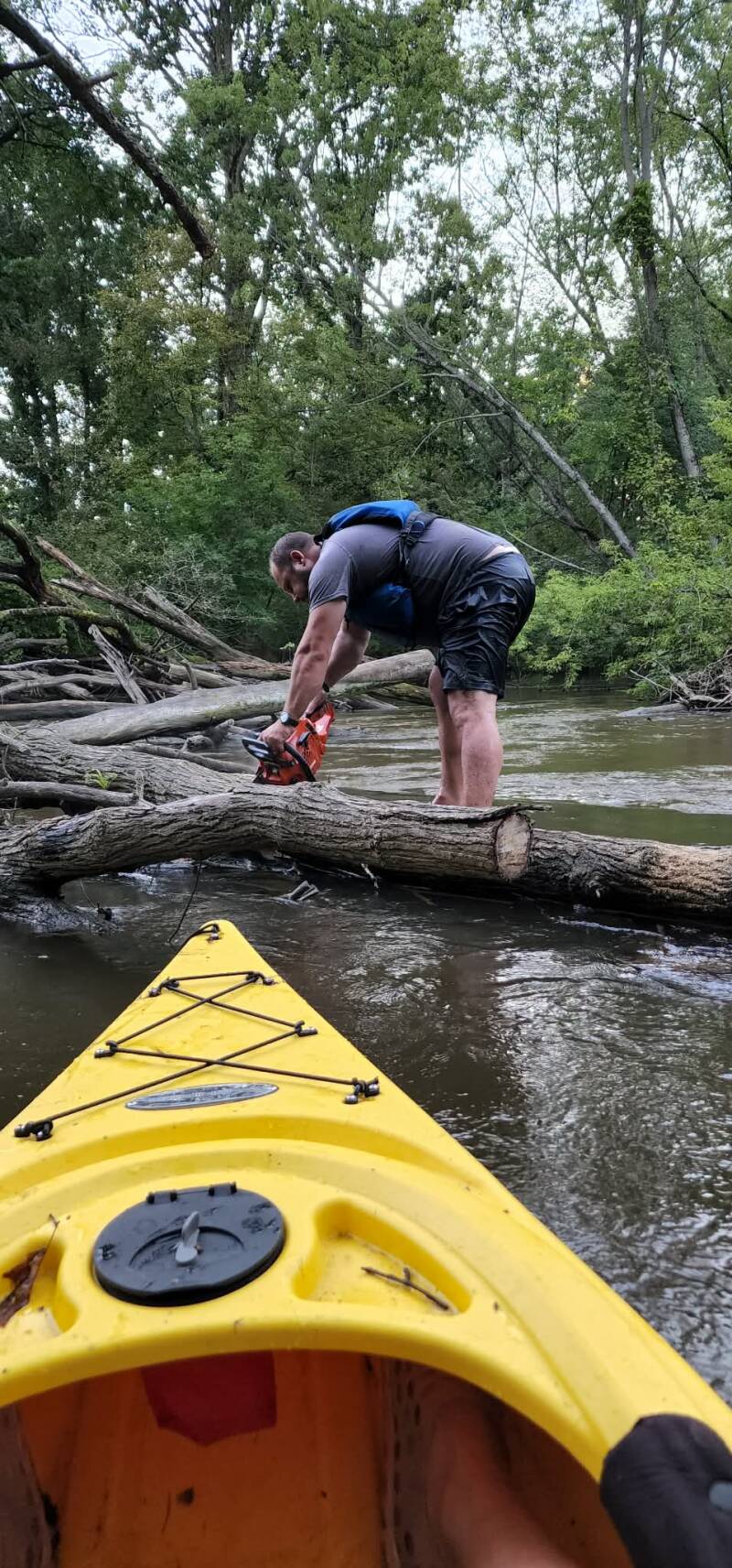
Get out and start cutting.
The boats were pulled into whatever small piece of accessible shoreline we could find.
Then the saws came out.
Branches had to be cut away.
Larger limbs had to be removed.
Logs had to be repositioned or cut into manageable sections.
Sometimes the entire group had to work together simply to create enough room for the boats to get through.
Then we’d climb back into the kayaks, paddle a few hundred yards—and find another blockage.
And another.
And another.
That was Crockery Creek.
And the battle had only begun.
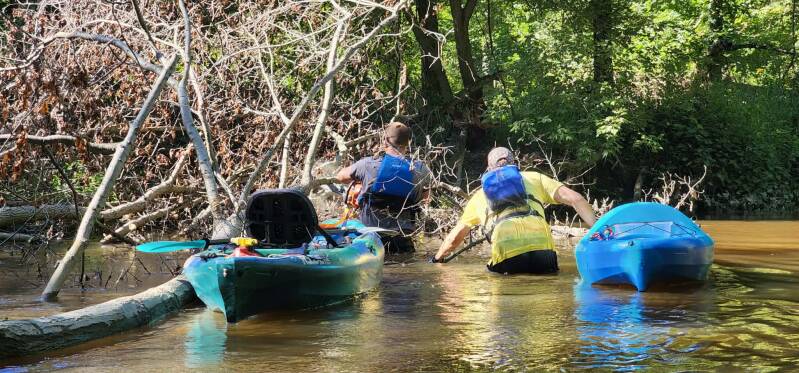
Crockery Creek wasn’t defined by one enormous obstacle.
It was defined by the relentless succession of obstacles.
A river that should have carried us downstream became a repeating cycle:
Paddle. Stop. Assess. Cut. Clear. Drag. Paddle again.
The farther we traveled, the more physically demanding the work became.
We were constantly moving between the water and the riverbank. We carried equipment through mud and brush. We crawled over and around fallen trees. We cut branches hanging into the channel and opened passages through places that had become almost impossible to navigate.
There were moments when it felt like the creek was determined to keep us from reaching the Grand River.
But we kept moving.
When the Worst Blockages Appeared
Some blockages were simple.
A few cuts and we could get through.
Others were completely different.
A large fallen tree could stretch across the entire width of the creek, with branches extending downstream and creating an enormous tangle of wood.
The current would push against the obstruction.
Water would squeeze underneath and around it.
There might be only a narrow opening where a kayak could pass.
Sometimes there wasn’t even that.
Those were the moments when everyone had to get involved.
The boats had to be moved out of the way.
The safest cutting points had to be identified.
Branches had to be removed first.
Then larger pieces.
Then the remaining obstruction had to be moved or cut apart.
Only after the channel was open could we get back in our boats.
The River Kept Testing Us
We quickly learned that clearing one blockage didn’t mean the work was over.
It meant we had earned the next section of river.
Round a bend.
Find another tree.
Pull over.
Cut.
Clear.
Launch again.
The process repeated itself over and over.
What would normally have been a long paddle became a physical expedition.
Our progress wasn’t measured simply by miles traveled.
It was measured by miles opened.
And mile after mile, the creek began to change.
The channel behind us was becoming more navigable.
The river ahead remained unknown.
And the Grand River was still a long way downstream.
Continue to Part 3: When the Chainsaw Came Out.
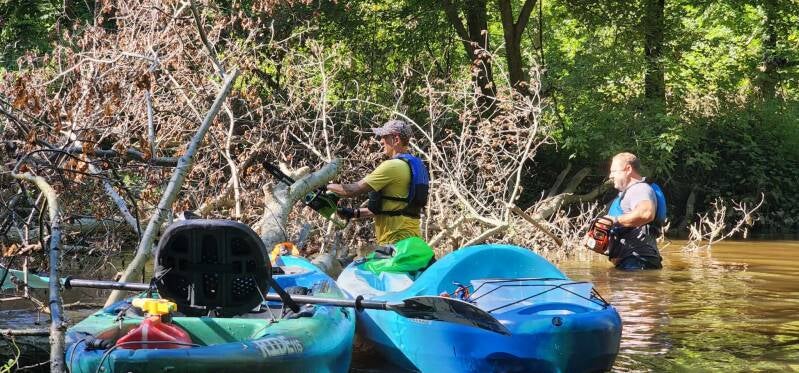
There is something about starting a chainsaw beside a river that changes the entire character of an expedition.
One minute you’re paddling through the quiet Michigan woods.
The next, the sound of a saw cutting through timber echoes down the creek.
This was river clearing at a completely different level.
But a chainsaw isn’t a magic wand.
It still takes planning.
It still takes teamwork.
And it still takes a lot of physical effort.
We had to determine where to cut, how the tree was positioned, where the pieces would go and how to create a passage without creating another hazard.
Other obstacles could be handled with hand saws, axes or loppers.
Sometimes the answer wasn’t a power tool at all.
Sometimes it was simply several people working together.
Tools of the Expedition
Our equipment became just as important as our boats.
Chainsaws.
Hand saws.
Axes.
Loppers.
And plenty of determination.
Every tool had its purpose.
Large trees required larger equipment.
Smaller branches could be attacked with hand tools.
Loppers were invaluable for clearing the smaller growth that made already difficult sections even harder to navigate.
But equipment alone wasn’t enough.
We had to work as a team.
Clearing Without Destroying the River
There was an important distinction throughout the project.
We weren’t trying to remove every fallen tree from Crockery Creek.
Natural woody debris is part of a healthy river environment and can provide habitat for fish and wildlife.
Our objective was to address major obstructions that prevented safe passage and made sections of the creek effectively impassable.
That required judgment.
Some trees stayed.
Some branches stayed.
But the major blockages standing between paddlers and the downstream river had to be dealt with.
The Reward
After the cutting was finished, there was always a moment we looked forward to.
The tools went back into the boats.
Everyone climbed aboard.
And someone would push off into the newly opened channel.
The current would take over.
For a moment, there was nothing to do except paddle.
Then we’d round another corner.
And see another tree.
Back to work.
That was Crockery Creek.
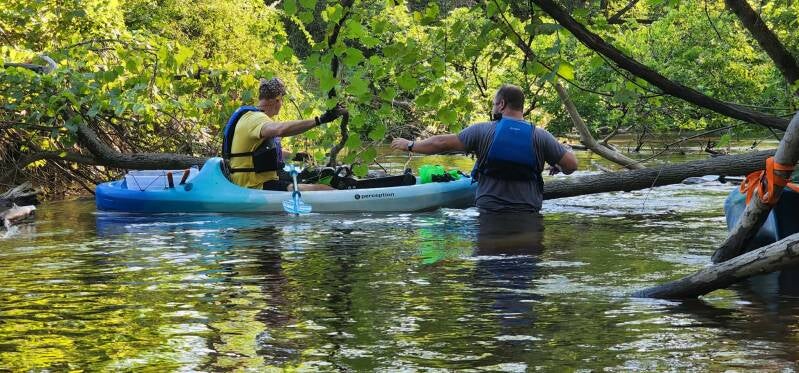
Approximately 36 miles.
That’s the number that stands out when we look back at the Crockery Creek project.
Thirty-six miles of river.
Thirty-six miles of bends, backwaters, fallen trees, branches and surprises.
And every mile had to be earned.
The creek continually changed character.
One section might offer relatively easy paddling.
Then we’d round a corner and discover a wall of timber.
We’d stop.
The boats would be secured.
The tools would come out.
And the work would begin again.
Mile After Mile
The difficult part wasn’t necessarily any individual tree.
It was the accumulation of them.
The repeated stops.
The repeated cuts.
The repeated climbs out of the boats.
The mud.
The brush.
The sweat.
The scratches.
The physical effort of moving equipment and clearing a path.
Then getting back into the kayak and doing it all over again.
That’s what made the project an endurance effort.
Watching the River Open
There is something uniquely satisfying about watching a blockage disappear beneath your hands.
A tree that had stopped everyone who came before you suddenly isn’t there anymore.
The current opens up.
The boats move forward.
And the river continues.
Behind us were miles of creek we’d already worked through.
Ahead was more river.
And eventually, the creek would carry us toward its destination:
the Grand River.
More Than a Number
Thirty-six miles is more than a distance.
For us, it became a measure of determination.
It represented the number of miles our group was willing to fight through.
It represented countless individual obstacles.
And it represented the beginning of something bigger for West Michigan Kayaking Club.
We weren’t simply paddling Michigan’s rivers.
We were learning them.
We were learning how they moved.
Where they narrowed.
Where trees fell.
Where debris accumulated.
And how much work could be required to make a river navigable again.
Sometimes the best adventures aren’t found on a map.
Sometimes you have to make the route yourself.
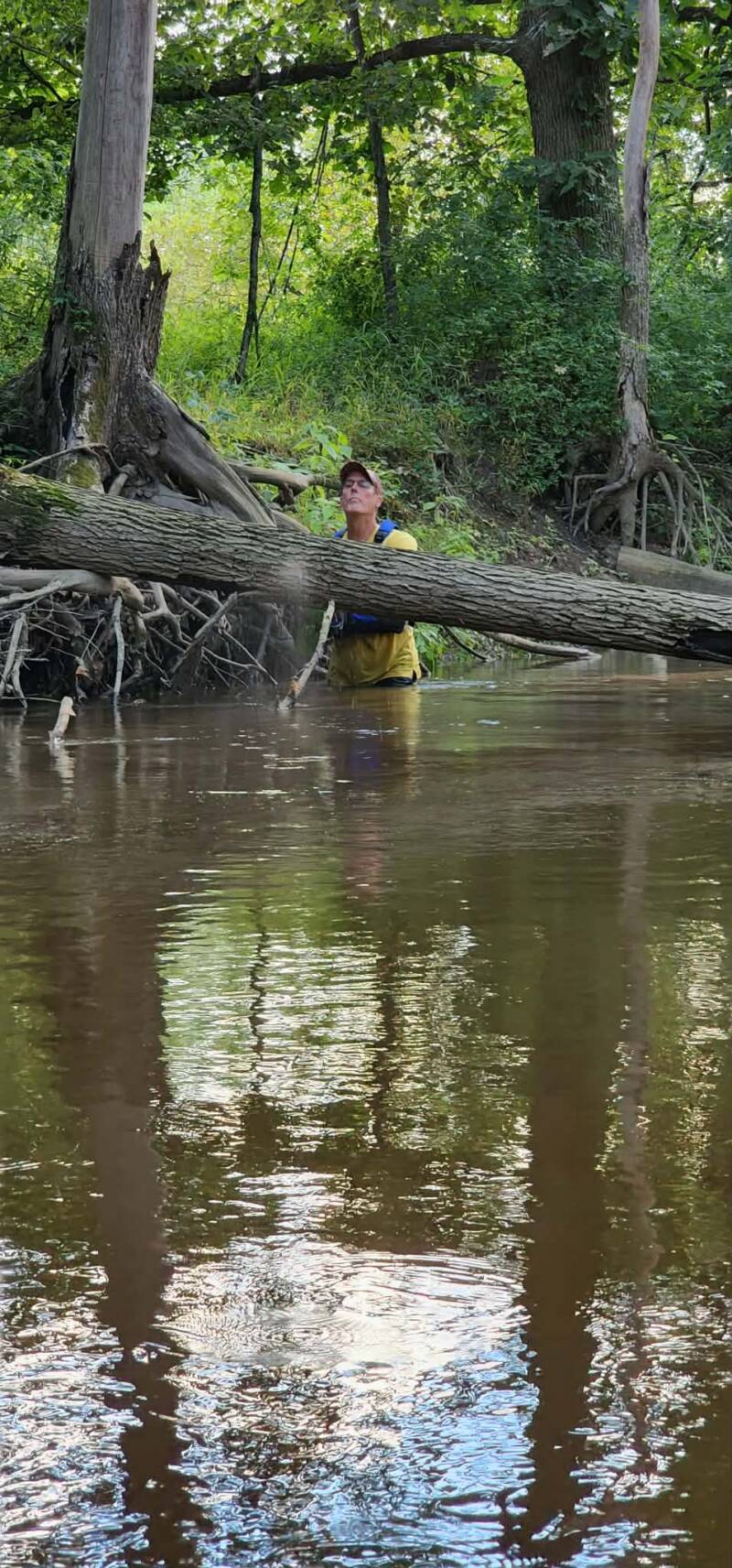
Years later, the memory of Crockery Creek still stands out.
Not because it was glamorous.
It wasn’t.
It was exhausting.
It was dirty.
It was physically demanding.
And at times it was downright frustrating.
But those are often the trips that become legends.
The ones where the plan changes.
The ones where the river wins a few battles.
The ones where everyone has to work together.
And the ones where you finally look behind you and realize just how much ground you’ve covered.
The Long Fight Toward the Grand River
Our route continued downstream toward the mouth of Crockery Creek and its confluence with the Grand River.
By then, the project had become a true endurance effort.
We were tired, dirty and scratched up.
But behind us was something tangible.
Miles of river that had been opened.
That is what made the work worthwhile.
We weren’t simply exploring Michigan.
We were interacting with the river in a completely different way.
We were learning its character.
And we were creating a story that would become part of the history of West Michigan Kayaking Club.
The Beginning of a Club Philosophy
Brad De Young and Tim Postma founded West Michigan Kayaking Club around a simple idea:
Paddling could be about more than casual floats.
It could be about exploration.
Distance.
Challenge.
River knowledge.
Stewardship.
And doing things that most people wouldn’t think to attempt.
Crockery Creek embodied that philosophy.
There was no leisurely float and easy finish waiting for us.
There were trees.
Lots of them.
And there was work to do.
The River Legend We Created
In August 2021, a group of West Michigan paddlers entered Crockery Creek with tools instead of simply paddles.
We fought through approximately 36 miles of fallen trees and debris.
We cut.
We cleared.
We dragged.
We paddled.
And we kept moving toward the Grand River.
Crockery Creek didn’t give us those miles.
We earned them.
A Michigan River Worth Remembering
Michigan is filled with rivers that have stories.
Some are famous for their rapids.
Some for their fishing.
Some for their history.
Others are remembered by the people who were willing to get off the beaten path and experience them firsthand.
For West Michigan Kayaking Club, Crockery Creek is one of those rivers.
It represents adventure, hard work, exploration and the willingness to take on something difficult simply because the challenge was there.
And that’s the kind of paddling community we wanted to build.
Not a club built around sitting on the shoreline.
A club built around going farther.
Going deeper.
And sometimes cutting our way through.
West Michigan Kayaking Club
Wild Rivers. Rugged Trails. Real Adventure.
West Michigan Kayaking Club is an adventure-focused paddling community based in West Michigan, bringing together kayakers, canoeists, SUP paddlers and outdoor adventurers for river expeditions, long-distance paddles, wilderness exploration, hiking and multi-day adventures.
Learn more at West Michigan Kayaking Club.
Join the official West Michigan Kayaking Club Facebook group.
#WestMichiganKayakingClub #CrockeryCreek #MichiganKayaking #MichiganRivers #MichiganPaddling #KayakingGrandRapids #RiverExploration #RiverCleanup #MichiganAdventure #WestMichigan