By Staff Writer | Michigan Watershed Watch/West Michigan Kayaking Club
There is a question at the center of Consumers Energy’s proposed sale of its 13 Michigan hydroelectric dams that Michigan residents deserve a straight answer to:
Is Consumers Energy trying to transfer the financial and environmental liabilities associated with these aging dams before those liabilities become even more expensive?
The question is not coming from speculation alone.
Consumers Energy has acknowledged that one of the purposes of the proposed transaction is to transfer future operational and environmental liabilities and risks to the new owner. The company has agreed to sell the 13 hydroelectric facilities to Confluence Hydro, an affiliate of Hull Street Energy, for $1. (Environmental Law & Policy Center)
Consumers Energy says the transaction will reduce long-term costs for its customers while keeping the dams operating and preserving the reservoirs and recreational benefits surrounding them. (Consumers Energy)
But that raises another question:
If these dams are valuable assets, why is Consumers Energy willing to sell all 13 for $1?
And more importantly:
If these dams carry enormous future maintenance, environmental, safety and decommissioning obligations, is the $1 sale effectively a transfer of those obligations along with the property?
Those are legitimate questions for the Michigan Public Service Commission to answer before approving the transaction.
These aren’t new pieces of infrastructure
Consumers Energy’s own records show that its hydroelectric fleet was built more than a century ago.
The 13 facilities were constructed between 1906 and 1935 and operate on five Michigan rivers. (Consumers Energy)
That means Michigan communities aren’t dealing with new infrastructure.
They’re dealing with aging dams that require continuing inspections, maintenance, repairs, capital investment and eventual decisions about relicensing, rehabilitation or removal.
Consumers Energy itself has previously acknowledged that the future of the dams could involve several possibilities, including continued operation, sale, removal or replacement. (Consumers Energy)
Now the company wants to sell the entire fleet.
The liability issue is the elephant in the room
The most revealing part of this controversy may be the language surrounding liability.
A filing opposing the transaction cites Consumers Energy’s own application as stating that the proposed deal would allow the company to transfer substantial future operational and environmental liabilities and risks to Confluence. (Environmental Law & Policy Center)
That is a remarkable admission.
Consumers Energy isn’t simply selling an ordinary portfolio of productive assets.
It is transferring ownership of aging infrastructure that carries significant future obligations.
And once ownership changes, the central public-policy question becomes:
Who will actually have the financial capacity to deal with a major failure, an environmental disaster, a major spillway reconstruction, or eventual dam removal?
Michigan regulators have every reason to demand an answer.
Michigan officials have already raised the same concern
The Michigan Department of Natural Resources previously warned that any new owner must have sufficient financial resources, qualified personnel, insurance and long-term plans to maintain dam safety.
The DNR also stated that dam removal is the best way to minimize dam-failure risk, while recognizing that continued operation requires diligent and well-funded monitoring and maintenance. (Consumers Energy)
Those concerns haven’t disappeared simply because a buyer has been identified.
In fact, they become more important when ownership is moving from a large regulated utility to a private entity.
Michigan Gov. Gretchen Whitmer has also opposed the proposed transaction, arguing that the agreement lacks sufficiently strong protections to guarantee long-term maintenance, accident liability coverage, financial reserves and eventual decommissioning. (Big Rapids News)
That’s not a minor disagreement.
It goes directly to the question of who ultimately bears the risk.
A $1 sale demands extraordinary scrutiny
Selling 13 dams for $1 might sound like a bargain.
But the real value of a transaction cannot be measured by the purchase price alone.
If the buyer receives the operating assets while assuming future obligations that could cost hundreds of millions of dollars, the critical question becomes whether those obligations are adequately funded.
And if they aren’t?
The risk doesn’t disappear.
It moves.
It can move to taxpayers.
It can move to property owners.
It can move to ratepayers.
It can move to local governments.
And, in the worst-case scenario, it can move to communities living downstream.
That’s precisely why Michigan cannot treat this as an ordinary corporate transaction.
Hardy Dam provides an important warning
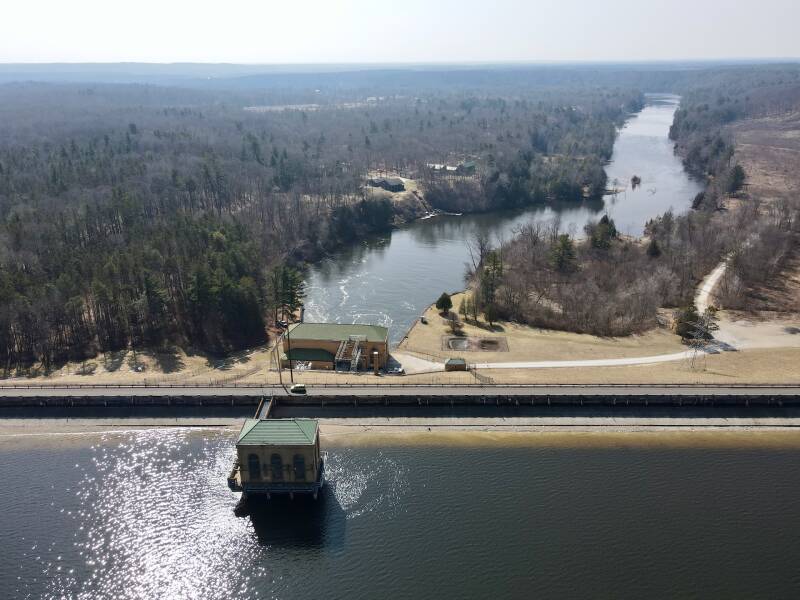
Consumers Energy’s own website says its Hardy Spillway project was paused while the company negotiated the future of its 13 hydroelectric facilities.
The company says interim risk-reduction measures remain in place to protect the public and the facility. (Consumers Energy)
That raises an obvious question:
What happens to major capital projects when ownership changes?
Who pays?
Who guarantees the money will be there?
Who is responsible if the estimated cost increases dramatically?
Who pays for emergency repairs?
Who pays if a dam must eventually be removed?
And who is responsible if a failure causes downstream damage?
These questions should be answered before ownership changes—not after.
This isn’t about blaming one company
The issue isn’t whether Consumers Energy is a good company or whether Confluence Hydro can operate hydroelectric facilities.
The issue is accountability.
Consumers Energy has owned these dams for decades.
It has operated them.
It has benefited financially from them.
And it now wants to transfer ownership at a time when the infrastructure is more than a century old and future capital requirements are becoming increasingly important.
That doesn’t automatically make the proposed sale wrong.
But it does mean Michigan regulators should scrutinize the transaction with extraordinary care.
Because once ownership changes, getting accountability back may be much harder.
Michigan shouldn’t allow liability to become a shell game
The state has already experienced the consequences of inadequate dam oversight.
The Edenville and Sanford dam failures in 2020 demonstrated what can happen when dam safety becomes a question of who is responsible for paying rather than who is responsible for preventing failure.
Michigan should not repeat that lesson.
If these dams are going to remain in place, Michigan needs enforceable guarantees that the owner has the financial resources to maintain them, repair them, insure them and ultimately remove them if they can no longer be operated safely or economically.
A promise isn’t enough.
A corporate structure isn’t enough.
And a safety fund that may not cover the full long-term liability isn’t enough.
Michigan needs legally enforceable accountability.
The question regulators must answer
Consumers Energy says selling the dams is the best path forward.
Critics say the transaction could transfer substantial long-term risks away from Consumers Energy and toward a private owner and, ultimately, Michigan communities.
Both sides cannot be right about the level of risk.
That’s why the Michigan Public Service Commission must look beyond the purchase price and corporate promises.
It must examine the entire lifecycle of these dams:
Who pays for maintenance?
Who pays for major repairs?
Who pays for environmental damage?
Who pays for an emergency?
Who pays for eventual decommissioning?
And who pays if the owner doesn’t have enough money?
Those aren’t hypothetical questions.
They’re the questions that determine whether Michigan residents are being protected—or whether responsibility is simply being transferred from one balance sheet to another.
The public deserves an answer before the deal is approved.
Because when you’re talking about 13 aging dams holding back millions of gallons of water above Michigan communities, liability isn’t a line item on a spreadsheet. It’s public safety.
Drop the dam—or prove you can safely and responsibly keep it.
Michigan Watershed Watch/West Michigan Kayaking Club
Investigating Michigan’s rivers, dams, watersheds and the decisions that shape their future.
Wild Rivers. Rugged Trails. Real Adventure