A day paddle ends at the take-out. A kayak camping trip doesn't. Somewhere around the moment you push a loaded boat off the bank — tent, food, and everything you need for the next several days sealed inside the hull — paddling becomes something bigger: travel. Kayak camping in Michigan is one of the most rewarding ways to experience this state, because Michigan is built for it. Long, paddleable rivers run for days through state and national forest, public campgrounds sit within reach of the water on river after river, and a paddler who learns the craft can cross whole watersheds under their own power, sleeping on a different bank every night.
This guide is about understanding how that works — the thinking behind Michigan kayak camping trips, not just the packing list. (A step-by-step expedition planning walkthrough is coming later in this series.) Get the concepts right, and the details fall into place on any river you choose.
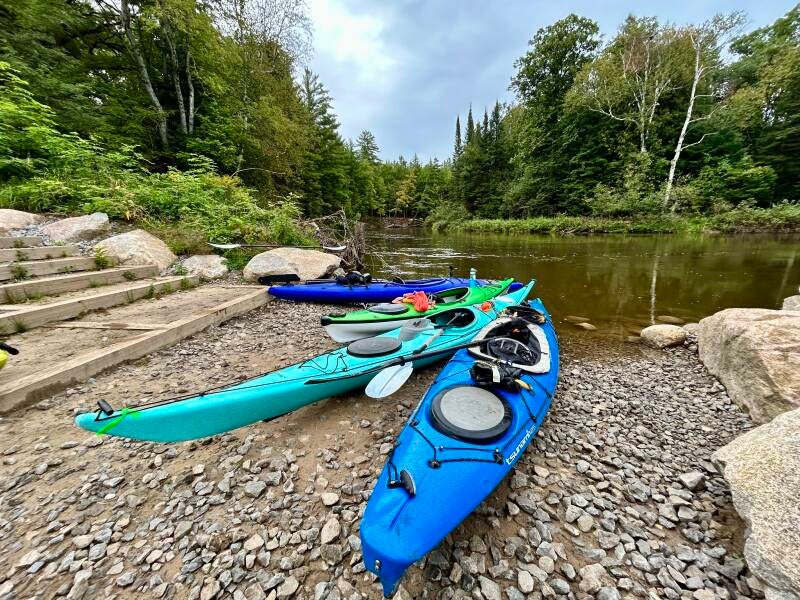
Why Michigan Is Made for Kayak Camping
Start with geography. Michigan has thousands of miles of rivers, and many of its best-known paddling rivers — the Manistee, the AuSable, the Muskegon, the Pine, the Sturgeon, and dozens of smaller watersheds — run through or alongside large blocks of public land. That matters more than scenery. A multi-day trip needs somewhere legal to sleep every night, and in Michigan the map often provides: state forest campgrounds on or near the water, national forest land along entire corridors, and county and township access sites spaced down many rivers.
The second ingredient is rhythm. Michigan rivers are mostly moderate — moving water, riffles, bends, and wood to dodge rather than big whitewater — which means a loaded touring kayak is a practical expedition vehicle here. You can cover real distance each day, stop where the map and the rules allow, and do it again tomorrow. Multi-day kayaking trips in Michigan tend to be journeys, not survival exercises.
The third ingredient is season. Late spring through fall offers a long window, and each part of it has a personality: high, cold water in spring; long evenings and warm nights in summer; quieter rivers and cold, clear mornings in fall. Kayak camping rewards people who match the trip to the season instead of fighting it.
How a Multi-Day River Trip Actually Works
A day trip is an out-and-back errand. A river expedition is a one-way journey, and everything follows from that.
The shuttle is the trip. Before a wheel turns, someone has solved the puzzle of vehicles: boats and people start at the put-in, and transportation has to be waiting at the take-out, days later and many miles downstream. On club trips this is a coordinated group effort; on private trips it is the first problem you solve, not the last.
Daily mileage is a decision, not a default. New kayak campers almost always plan too many miles. A loaded boat handles differently, camp chores take time, and the river sets its own pace with current, wind, and obstacles. Experienced trip planners think in comfortable days — enough miles to feel like travel, few enough to leave margin for weather, a swim stop, or an early camp when the group is tired. The best day on a river trip often ends earlier than planned.
Camp is a skill, not a stop. Choosing where to sleep blends the map, the rules, and judgment: Is this site legal to camp on? Is it above the high-water line? How far is the walk from the boats? A group that makes camp efficiently — boats secured, tents up, kitchen organized, food stored — buys itself the relaxed evenings that make people fall in love with this kind of travel.
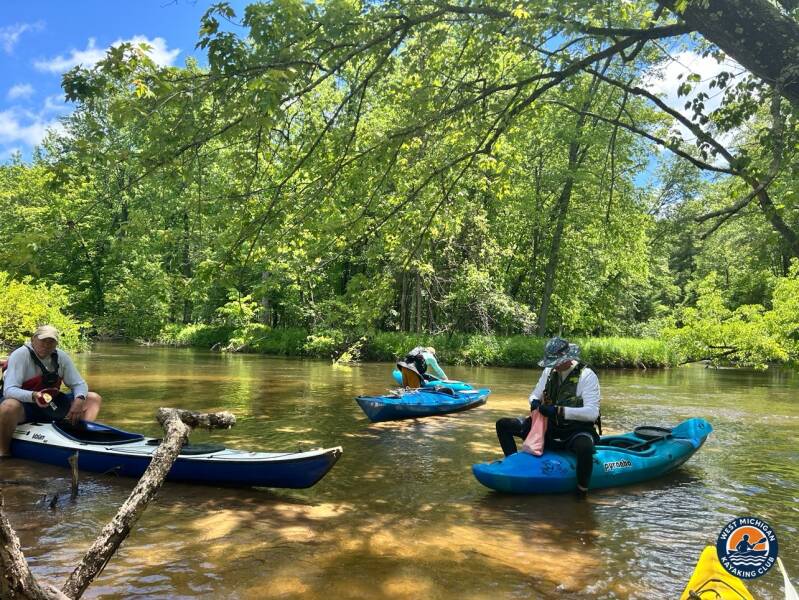
Where You'll Sleep: Understanding Michigan's Camping Options
Where you may camp on a Michigan river trip depends on who manages the land, and the honest answer is that it varies — so the working rule of kayak camping in Michigan is simple: identify the land manager for your stretch of river and check their current rules before you go. The main categories look like this.
State forest campgrounds
Michigan's state forest campgrounds are the backbone of many river trips: rustic sites, typically with a fire ring, picnic table, and vault toilet, managed by the Michigan Department of Natural Resources. Many sit on or near paddling rivers, and several of the club's multi-day trips are built around them — our AuSable River trip, for example, based out of Canoe Harbor State Forest Campground. Fees, reservation policies, and stay limits are set by the DNR and can change, so confirm the details for your dates rather than relying on anyone's memory, including ours.
National forest campgrounds and dispersed camping
Where rivers cross national forest — Huron-Manistee is the big one for Michigan paddlers — the U.S. Forest Service manages developed campgrounds and also allows dispersed camping in many areas, away from developed sites. Dispersed camping is a privilege with conditions attached: distance from water and trails, length-of-stay limits, and fire rules all vary by forest and sometimes by district. Treat "dispersed camping is allowed here" as a claim you verify with the forest's own current guidance, every time.
Everything else
Some stretches pass county parks, township sites, or private campgrounds that welcome paddlers; others pass long runs of private bank where the only legal option is to keep paddling. A good trip plan names the night's destination before launch — and a backup. And wherever you sleep, Leave No Trace is the standard: pack out everything, use established sites where they exist, and leave the bank so the next group can't tell you were there. You can see how two of these trips actually unfolded in our Manistee River trip report and AuSable River trip report.
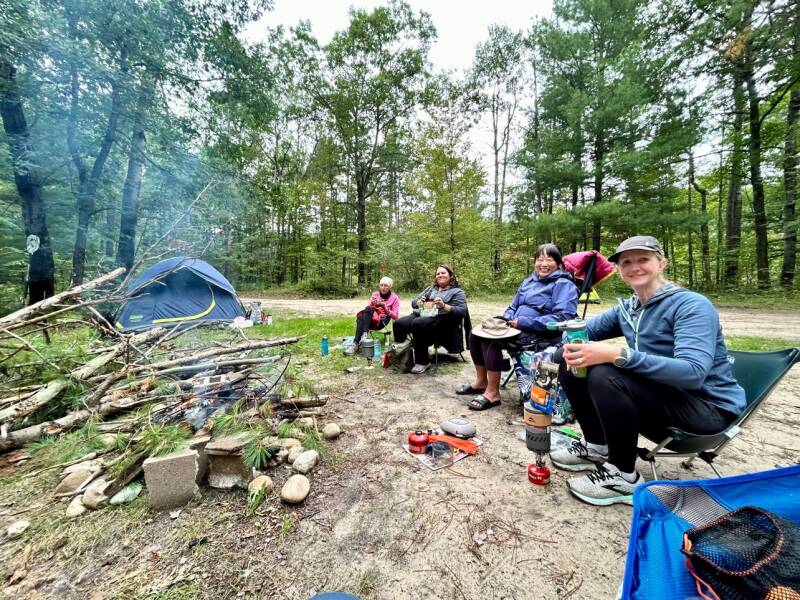
The Boat Is Your Backpack
The central craft of kayak camping gear is this: everything you carry must fit inside a kayak, stay dry in a wet environment, and keep the boat balanced. Backpackers think in liters and pounds; kayak campers think in hatches and trim.
Loading is balance. Heavy items go low and close to the center of the boat; the load is split between bow and stern so the kayak sits level. A stern-heavy boat weathercocks and wallows; a bow-heavy boat plows. Load the boat, paddle a short test, adjust — that five-minute check on day one is worth more than any packing theory.
Dry bags are the system. Nothing inside a kayak is truly dry — hatches leak, waves splash, and eventually someone swims. Sleeping gear and clothing live in dry bags, period. Organize by function (sleep, clothes, kitchen, food) so camp setup doesn't mean emptying the entire boat onto the bank.
Weight is a budget. Every luxury costs handling and energy. The paddlers who enjoy long Michigan river kayak trips are ruthless about multi-use items and honest about what they'll actually use — and they spend the savings on good sleep, because a warm, dry, rested paddler is a safe paddler. The club's river guide library is a good place to match boat and load to the river you're planning.
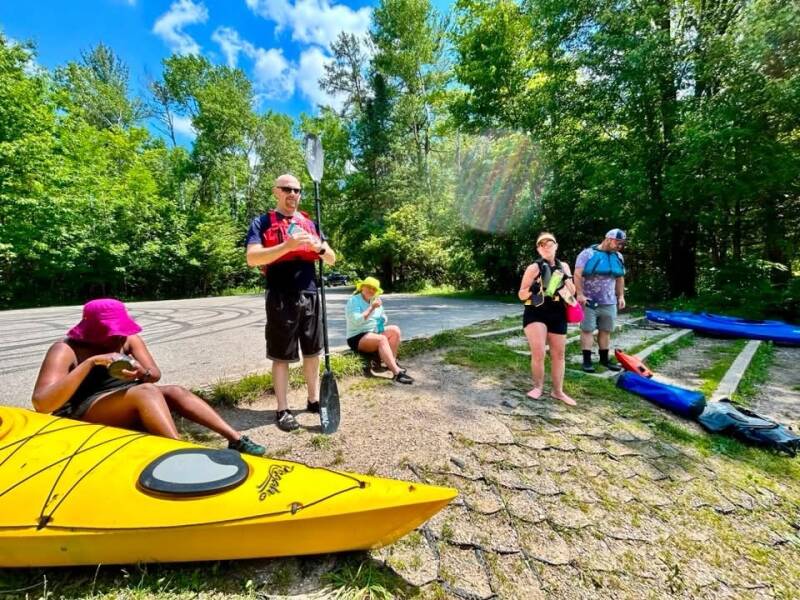
Food and Water: The Two Weights That Change
Food and water are the only loads that shrink as the trip goes on, and planning them well is mostly about thinking in systems.
Water first. River water in Michigan is not drinking water until it's treated — assume every source needs filtration or purification. Most kayak campers carry a quality filter and a backup method, fill up at camp in the evening, and start each day with full bottles. On stretches where treated water is available at campgrounds, use it and lighten the load; where it isn't, the filter is not optional equipment.
Food is morale plus fuel. Expedition eating works best when it's planned as group or personal systems with a rhythm: simple breakfasts, no-cook lunches eaten wherever the day pauses, and one real cooked dinner in camp. Protect food from animals — hang it or store it in hard-sided containers according to local practice and rules — and pack out every scrap. Hunger makes people careless; a fed group makes better decisions.
Reading the River and the Weather
A day paddler can shrug at a forecast. A kayak camper lives inside one for several days, so river conditions and weather become planning tools, not background noise.
Know your river's normal range before you go. Our current water levels page gathers the relevant gauges, and the U.S. Geological Survey publishes the underlying real-time data. The skill isn't reading a number — it's understanding what rising water does to strainers and landings, what low water does to your mileage, and when the honest answer is to shorten the day or stay in camp.
Weather works the same way. Michigan fronts can turn a warm afternoon into a cold, wet night, and on a multi-day trip there is no driving home from the weather. Dress and pack for the water temperature as much as the air temperature, build an unplanned layover day into longer trips when you can, and treat lightning and high wind as hard stops. The margin you planned on paper is what you spend out there.
Safety Is a System, Not a Gear List
On a multi-day trip, small problems compound: a wet sleeping bag, a lost shuttle key, a sore shoulder on day two. Expedition safety is mostly the discipline of keeping small problems small. That means a worn PFD, every day, in every condition. It means a trip plan filed with someone at home — route, camps, take-out, and the day to start worrying. It means the group stays together, communicates about stops and obstacles, and carries repair and first-aid capacity matched to the distance from the nearest road.
West Michigan Kayaking Club trips are member-led and self-supported: everyone is responsible for their own boat, gear, and decisions, and trips are rated by difficulty so members can choose water honestly. That culture is itself a safety system — people who plan together tend to look out for each other. Our safety page lays out the club's expectations in full.
Your First Multi-Day Trip: Start Smaller Than You Think
The classic first kayak camping trip is one night, on a river you already know, in good weather, with an easy bail-out. One night teaches you 90 percent of the craft — loading, camp routine, morning breakdown — at almost no risk. From there, the ladder is natural: a two-night trip, a new river, a longer expedition.
That's how many of our members built up to trips like the club's three-day Manistee River expedition and its multi-day AuSable adventure, and it's the spirit behind the club's planned Nordhouse Dunes trip in June 2027 — bigger water, bigger country, same fundamentals. Kayak camping in Michigan scales from a single night to a week on the river, and every step of it runs on the same ideas: know your land manager's rules, load the boat with intention, plan food and water as systems, read the river, and leave margin.
The club calendar is where upcoming trips are posted. Bring a day-paddler's skills and a camper's curiosity, and the rivers will do the rest.
Explore Michigan with West Michigan Kayaking Club
Looking for more than an occasional paddle? Join the West Michigan Kayaking Club, a Grand Rapids-based outdoor adventure community exploring Michigan's rivers, lakes, trails, and wilderness.
Our adventures include active day paddles, multi-day river expeditions, kayak camping, hiking, backpacking, cycling, and outdoor exploration.
We believe in getting out there, covering miles, and discovering what's around the next bend.
Wild Rivers. Rugged Trails. Real Adventure.
Membership is free. There are no dues or membership fees.
Website: https://www.westmichigankayakingclub.online
Become a member: https://www.westmichigankayakingclub.online/become-a-member
Facebook community: West Michigan Kayaking Club
By Brad De Young | Co-Founder, West Michigan Kayaking Club
The Kayakers Journal
Add comment
Comments