By Brad De Young | Michigan Watershed Watch
After nearly a century of absence, Michigan’s Arctic grayling restoration effort has reached an important early milestone. Although biologists have yet to confirm the survival of released fish in the wild, tribal communities and conservation partners remain hopeful that this iconic native species can once again thrive in Michigan’s rivers.
Michigan’s rivers have a long memory, even when the fish that once inhabited them are gone.
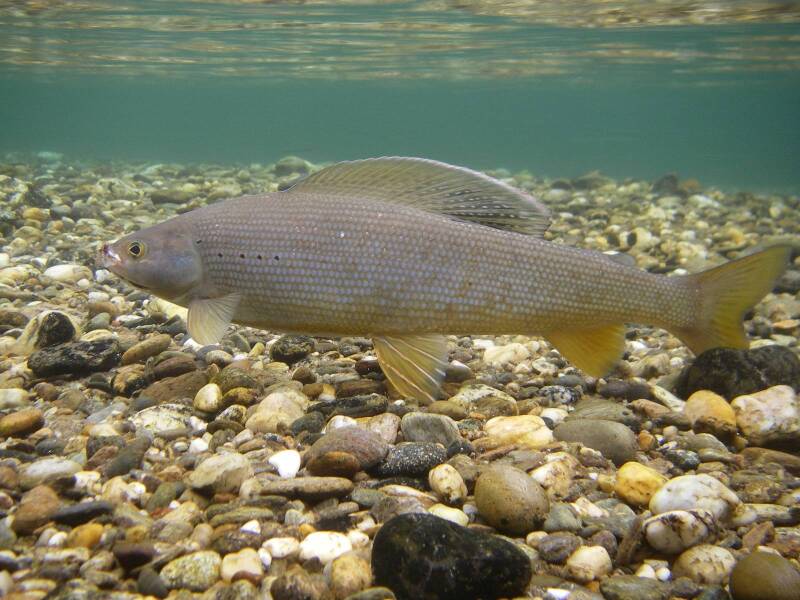
For generations, Arctic grayling swam through the cold, clear streams of Michigan’s northern Lower Peninsula. Their iridescent bodies and distinctive sail-like dorsal fins made them one of the region’s most remarkable native fish. They were an important food source for Indigenous communities and helped establish northern Michigan as a destination for anglers.
Then they disappeared.
By 1936, Arctic grayling had been extirpated from Michigan’s waters. Overfishing, extensive logging, habitat destruction and changes in river conditions contributed to their decline. Introduced brown trout added another challenge, competing with grayling and affecting their survival.
Nearly 90 years later, Michigan is trying to bring them back.
As of October 2026, the latest chapter in that effort offers both reasons for concern and grounds for cautious optimism. One year into the renewed river restoration program, researchers have yet to recapture a released grayling in the wild. But the absence of confirmed sightings does not, by itself, establish that the effort has failed.
Instead, it highlights just how difficult restoring a species can be when the original habitat, ecological relationships and environmental conditions have changed.
A Collaborative Effort to Restore a Native Species
The current restoration effort brings together the Michigan Department of Natural Resources, tribal nations, researchers and conservation partners through the Michigan Arctic Grayling Initiative.
In May 2025, the state provided approximately 400,000 Arctic grayling eggs to three northern Michigan tribal partners: the Little River Band of Ottawa Indians, the Little Traverse Bay Bands of Odawa Indians, and the Grand Traverse Band of Ottawa and Chippewa Indians.
The restoration sites include the North Branch of the Manistee River, the Maple River and the Boardman-Ottaway River.
The eggs originated from Alaska’s Chena River population, one of the remaining North American sources of Arctic grayling used for the program.
This approach builds on lessons from earlier restoration attempts. Rather than simply raising fish in hatcheries and releasing them into rivers, conservation partners are also using in-stream incubators that allow young grayling to hatch and begin life in their intended habitat.
The goal is to improve the chances that fish will adapt to local river conditions and eventually establish reproducing populations.
The work represents years of planning, research and investment. It is also an acknowledgment that successful restoration requires more than putting fish back into the water. The rivers must provide the conditions those fish need to survive.
No Confirmed Recaptures, but the Story Is Not Over
The latest monitoring results underscore the uncertainty surrounding the effort.
Biologists with all three tribal partners have yet to recapture a grayling from the initial releases. Flooding, storm damage and the difficulty of locating small fish in large river systems have complicated surveys.
The Little River Band of Ottawa Indians placed hundreds of thousands of eggs in in-stream incubators along the Manistee River near Kalkaska. Researchers observed tens of thousands of young fish leaving the incubators, but confirming their subsequent survival has proved difficult.
On the Boardman-Ottaway River, the Grand Traverse Band raised and released approximately 8,000 young grayling during the summer and early fall of 2026. That was a substantial improvement over the previous year, when a power outage at the tribe’s rearing facility killed most of its fish.
Researchers have also detected signals from tags associated with fish released the previous year. Those signals are encouraging, but they have not conclusively established that the tagged grayling survived.
The distinction matters. Conservation requires an honest assessment of what monitoring can demonstrate, not simply a tally of fish released or hopeful interpretations of incomplete data.
Biologists estimate that it could take six to eight years to determine whether the restoration effort is succeeding. Until then, continued monitoring and adaptive management will be essential.
Michigan’s Rivers Face a Changing Climate
Even if the young grayling survive their first years, they face a changing environment.
Arctic grayling are adapted to cold-water conditions. Climate change, warmer stream temperatures and increasingly extreme weather could make suitable habitat harder to maintain.
Recent flooding and ice storms have also made some restoration sites difficult to access and evaluate. High water, shifting stream conditions and storm debris can complicate fieldwork and make it harder to determine where fish are surviving.
These challenges illustrate a broader issue facing watershed conservation across Michigan: protecting a river means considering the entire system, including water temperature, flow, stream structure, surrounding land and the effects of human activity.
Cold-water fish need more than clean-looking water. They depend on the physical and biological conditions that allow them to feed, grow, avoid predators and reproduce.
Restoration planning will therefore need to account for long-term climate trends alongside immediate habitat conditions.
Brown Trout and the Complexity of Restoration
Another challenge is the ecological landscape grayling would encounter if they return.
Michigan’s rivers have changed considerably since Arctic grayling disappeared. Brown trout and other established species now occupy habitats where grayling once lived.
Research published in 2026 by U.S. Geological Survey scientists examined competition between young Arctic grayling and young brook and brown trout. The experimental findings indicated that brown trout negatively affected grayling growth, condition and survival, while brook trout did not produce comparable effects under the study conditions.
That finding does not mean every river containing brown trout is unsuitable for grayling. Conditions vary from stream to stream, and controlled experiments cannot answer every question about a complex natural ecosystem.
However, the research reinforces the importance of carefully selecting restoration sites and understanding the ecological pressures young grayling may encounter.
A successful program will require more than producing enough eggs or releasing enough fish. It will require identifying places where grayling have a realistic chance to survive and eventually reproduce.
Restoration Is About More Than One Fish
The return of Arctic grayling would represent more than the recovery of a beautiful fish. It would reconnect Michigan’s waterways with an important part of their natural history and cultural heritage.
For the tribal communities leading this work, grayling restoration also has deep cultural significance. The fish was historically important to Indigenous food systems, traditions and relationships with the land and water.
That makes this effort especially meaningful. Restoration is not simply about returning a species to a map. It is about rebuilding relationships between communities, ecosystems and the natural resources that have sustained them.
Michigan has made progress in protecting water quality, improving stream habitat and recognizing the value of healthy watersheds. But the grayling effort demonstrates that ecological recovery can take decades, and some losses are difficult to reverse.
It also demonstrates why long-term monitoring matters. Without reliable data, it is difficult to distinguish a temporary setback from a fundamental problem or to determine which restoration methods deserve further investment.
Hope Requires Patience, Science and Healthy Rivers
The absence of confirmed grayling recaptures after a year is disappointing, but it is too early to declare the effort a success or a failure.
The next several years will be critical. Researchers will need to continue surveying restoration sites, evaluate survival and growth, investigate predation, and adjust their methods as new information becomes available.
Larger fish at release, improved rearing methods and better understanding of habitat requirements may improve survival. At the same time, warming water, extreme weather and ecological competition will remain serious concerns.
The larger lesson extends well beyond Arctic grayling.
Michigan’s rivers are living systems, shaped by decades of land use, pollution, habitat alteration and restoration. Bringing a native species back requires understanding those systems and accepting that recovery rarely follows a predictable schedule.
For those who paddle, fish, hike and spend time along Michigan’s waterways, the grayling effort is a reminder of what is at stake when we protect our rivers.
A river is more than a route through the landscape. It is habitat, history and a living connection between communities and the natural world.
Michigan’s Arctic grayling have not yet made a confirmed return to the wild. But the work continues, and the coming years will provide a clearer picture of whether this remarkable native fish can once again find a home in the waters where it belongs.
Hope remains. The real test will be whether Michigan can give that hope the healthy rivers and long-term commitment it needs to become a lasting recovery.
Add comment
Comments