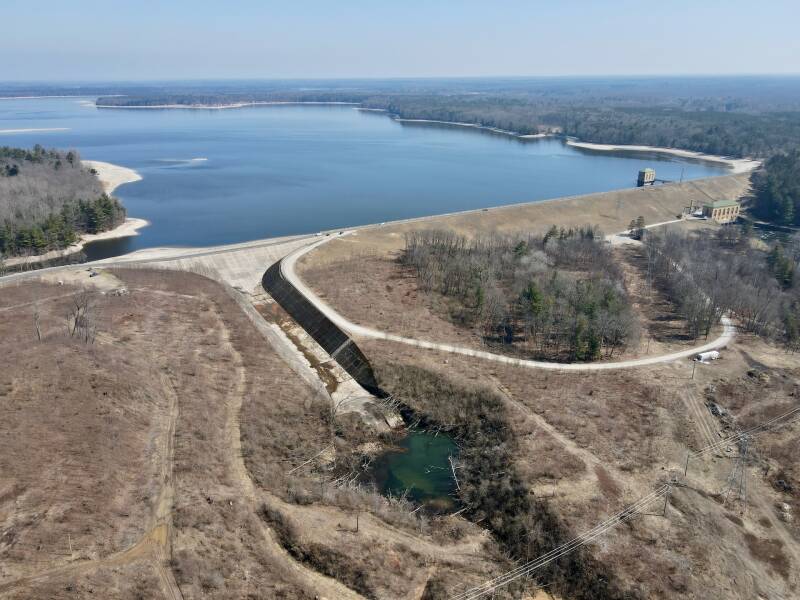
Hardy Dam on the Muskegon River is Michigan’s largest hydroelectric dam. It is also a high-hazard structure whose failure would put thousands of people and hundreds of millions of dollars in property at risk downstream, stretching into Muskegon County. After federal regulators updated flood estimates, Hardy no longer meets the standard requiring high-hazard hydropower dams to safely pass the probable maximum flood—the largest flood scientists consider physically possible at the site. The existing auxiliary spillway is undersized. A major storm could overwhelm it.
In past filings with state and federal regulators, Consumers Energy itself called the needed upgrades a “critical need.” Without them, the company acknowledged, federal regulators would likely revoke the dam’s license, and a major flood could destroy it. The fix is a roughly $350 million replacement of the auxiliary spillway, plus related work on the crest and splash wall. Construction was once planned to start years earlier. Under a 2024 Federal Energy Regulatory Commission order, it was supposed to begin in 2025. In a March 16, 2026 filing, Consumers asked FERC for permission to push the start date to December 31, 2028.
The stated reasons? It is “neither feasible nor prudent” to begin the work while the company awaits regulatory approvals and pursues a sale of Hardy and 12 other dams to a private equity-backed buyer, Confluence Hydro. Consumers has been clear: if the sale is rejected, it is unlikely to proceed with the spillway project and would instead move toward decommissioning. In other words, the utility that long described the upgrade as essential is now treating it as contingent on offloading the asset.
This is not an abstract engineering debate. Hardy is classified as high-hazard for a reason. A failure could kill people. Emergency planning materials estimate roughly 4,300 people and $230 million in property in the immediate downstream flood zone in Newaygo County alone, with impacts extending into Muskegon County. Broader assessments put tens of thousands of people in the overall flood zone. Damage to homes, roads, bridges, businesses, and the environment could climb into the billions of dollars.
If Hardy Dam failed, the consequences would cascade rapidly and catastrophically. The roughly 120-foot-high dam holds back a 4,000-acre reservoir. A sudden breach would unleash that water in a violent surge. Within minutes, a wall of water tens of feet high would slam into Croton Dam just downstream. Historical modeling from the near-miss of 1986 projected that Croton would fail about 75 minutes later under a roughly 47-foot surge. From there the flood wave would race toward Newaygo. Within roughly eight and a half hours, a 52-foot surge would hit the city, washing out the M-37 bridge and threatening the municipal water supply. Further downstream, a 46-foot wave would strike Old Woman’s Bend west of Newaygo. At the Muskegon County line near Maple Island Road—nearly 38 miles from Hardy—a still-destructive 19-foot surge would arrive in about 14 hours and destroy the county bridge.
Hours later the surge would reach Muskegon itself. Modeling showed a 19-foot wall of water hitting the Muskegon Causeway between the city and North Muskegon about 34 hours after a Hardy breach, washing it out. By the time the wave reached the Muskegon Channel at Lake Michigan, roughly 35 hours after failure, it would still stand about 22 feet high. Bridges at M-37, Maple Island Road, U.S. 31, and the Causeway would be gone, isolating communities and forcing the nearest river crossing more than 50 miles upriver. Low-lying neighborhoods, Harbour Towne on Muskegon Lake, and areas around Pere Marquette Park would be inundated. Homes, businesses, roads, utilities, and critical infrastructure would be destroyed or heavily damaged across a wide corridor.
Lives would be at stake. Evacuation windows would be short in the nearest communities and measured in hours farther downstream. Some residents simply would not get out in time. The 1986 near-failure left company supervisors describing the dams as “teetering on the edge.” A full breach then—or now—would have produced a disaster of historic scale for West Michigan. Property damage alone in the primary Newaygo County zone was already estimated at more than $230 million in older planning documents; inflation, population growth, and expanded development since then push the realistic total far higher. When homes, businesses, roads, bridges, utilities, environmental cleanup, emergency response, and long-term economic disruption are added, the bill easily reaches into the billions. Taxpayers and ratepayers would ultimately shoulder much of that cost through disaster aid, infrastructure rebuilding, higher insurance rates, lost tax base, and the inevitable lawsuits that follow catastrophic failures of regulated infrastructure.
Interim risk-reduction measures exist—primarily seasonal drawdowns of the reservoir (about 12 feet in winter). Conservation groups and the Michigan Department of Natural Resources have raised alarms that these may not be enough if the multi-year delay is granted. The Hydro Relicensing Coalition has asked FERC to require year-round lowering of Hardy Pond until the spillway is fixed, noting that major floods have occurred outside the current drawdown window. The DNR has opposed the delay until the adequacy of interim measures is assured, pointing back to a 2014 inspection that identified potential failure under design-basis storm scenarios and an inadequate spillway for the revised probable maximum flood.
Consumers maintains that safety is its highest priority and that interim measures will continue. Yet the pattern is damning. The company identified a critical safety gap, described the consequences of inaction in stark terms, then sought to postpone the remedy while trying to sell the problem to a private buyer under a deal that has itself drawn sharp criticism—including a judge’s recommendation against it on public-interest and safety grounds, and opposition from the Michigan Attorney General. Ratepayers have long underwritten these aging assets. Now the utility is effectively saying the permanent fix depends on transferring responsibility.
There is only one logical and safe conclusion. Full remediation of Hardy Dam—completing the $350 million auxiliary spillway replacement and associated safety upgrades without further delay—is the only responsible path forward. Temporary drawdowns and monitoring are stopgaps, not solutions. Selling the dam to a private equity entity does not erase the engineering reality or the public risk. Decommissioning may eventually be debated, but it does not address the present danger of operating a high-hazard structure that cannot pass the probable maximum flood. The documented safety gap must be closed. Anything less leaves tens of thousands of people downstream exposed to a preventable catastrophe while Consumers Energy continues to prioritize its preferred corporate exit over the clear warning it once issued about what happens if the spillway is not fixed.
The Federal Energy Regulatory Commission and the Michigan Public Service Commission must reject further delay and require the remediation to proceed on an accelerated timeline. Public safety demands it. Hardy Dam’s remediation is not optional. It is the only logical and safe conclusion
🚣 Follow West Michigan Kayaking Club! 🌲
Interested in kayaking, hiking, camping, and outdoor adventures across Michigan? Join our community of outdoor enthusiasts and follow us to stay up to date on upcoming events, river conservation news, and adventures!
🌐 Website: https://www.westmichigankayakingclub.online
📘 Join our Facebook Group: https://www.facebook.com/share/g/17wBZ9RP4w/
West Michigan Kayaking Club
Wild Rivers. Rugged Trails. Real Adventure.
#WestMichiganKayakingClub
Keep Exploring
Sand, Pine and Six Dams: Paddling the AuSable to Lake Huron
Consumers Energy's Dam Strategy: Public Safety Must Not Become a Bargaining Chip
Hodenpyl Dam Is Showing Warning Signs. Michigan Should Start Planning Its Removal.

Add comment
Comments